Showing posts with label Los Angeles Res.. Show all posts

Wednesday, April 10, 2013

Mervin J. Monnette -- 951 South Western Ave.

The Los Angeles Herald put a very large picture at the top center of its real estate section on that Sunday in 1905. Mr. Alfred Jeremy, a "Pittsburgh capitalist", had announced plans to build a new home on a small knoll located at Western Avenue and San Marino Street. The Herald explained:
"Some weeks ago Mr. Jeremy purchased four lots in the Country Club Heights tract, with frontage of 196 feet on Western avenue and 255 feet on San Marino street. The ground surmounts a knoll from which a fine view of the surrounding country can be had--the ocean to the south and Hollywood and the mountains on the north.
On this knoll will be erected a highly ornamental and commodious home of the old mission style of architecture from plans drawn by Dennis & Farwell, architects, at a cost of about $10,000. The porch and terrace on the south and east fronts are 12 to 14 feet wide. The reception hall finished in oak and with recessed seats will be 18x21 feet, with ornamented staircase at the rear of the hall. At the right of the hall the plans show the parlor 15x18 feet, and the living room 18x26 feet. In each room is a tile mantel, and French windows separate the living room and conservatory at the rear. Provision is made in the conservatory for a fountain.

The family dining room 19x26 feet with large mantel in oak, is at the left of the hall, and at the rear is the butler's pantry, a large kitchen and other home conveniences; also the servant's hall and a screen porch. The patio, 16x30 feet, is at the rear of the center of the residence, flanked by the living room and the kitchen.

On the second floor are five large bedrooms, two mantels, two bath rooms, besides numerous closets and balconies, one on the east front and one at the rear.

This improvement will be one of the show places of the southeastern [sic] section of Los Angeles."
As pictured in the L.A. Herald of June 11, 1905
(courtesy of cdnc.ucr.edu)
Another article later that year in the Herald mentioned Mr. Jeremy's intention to "be in by Christmas".

Meanwhile, in Goldfield, Nevada in September of 1905, a Mr. Mervin Jeremiah Monnette (1847-1931) had just signed an agreement with a Mr. Granville Hayes for 1/2 ownership in a two-year lease on a not-so-well-performing mine. Mervin, who was a cattle rancher in Omaha at the time, was sent by Chicago business associates earlier that year to check out an offered lease on another mine. The associates knew that Mervin, who had previously operated in Cripple Creek, was an "honest" man who would provide an impartial report. Mervin concluded that the mine was worthless and had been "salted". But since he had spent the time and effort to reach Goldfield, he remained in town to see if anything else might be worthwhile.

1906 Caricature of M. J. Monnette
He soon met Granville Hayes, who owned the previously mentioned lease, and who had been working it when he ran low on capital. Trusting Granville's long experience in mining, along with some promising assays of prior workings, Mervin decided to sign up, contributing $10,000 in capital for the 50% ownership position. He quickly saw that this would not be enough money, so he convinced two of his Chicago business partners, J.W. Smith and Harry Benedict, to join him. Another $25,000 was expended without uncovering any ore worth shipping, when in April, 1906 they hit the "mother lode".

From the Goldfield News, 1906-1907:

"...At this point in the sinking, Hayes had wanted to drift on the big body of low-grade ore then in evidence, believing that it would narrow down to a good-sized high-grade vein, and he had cut a station at the 80-foot point with that in view, but he had been dissuaded. He now returned to demonstrate his theory.
Hardly had the miners fired their first round of shots, when lo! and behold, the long-expected bonanza was at hand. Here was ore that needed no assayer's test. Sulphide ore which, by its very weight and dull yellow color in the glare of the candle light told that it was rich in gold. As the miners pushed inwards with their work the discovery became even more startling. It was one monstrous ore chamber that had apparently neither walls, tops nor bottom. Ore everywhere!" [1]
They ended up taking over $5 million in ore by January, 1907 when their lease expired.

Granville and Mervin ended up in Los Angeles and went their separate ways. Mervin contacted his son Orra (1875-1936), a successful lawyer back in Ohio, who came to L.A. to manage his father's new-found wealth. They spent a goodly sum on L.A. banks, installing Mervin as President of one purchase, American National Bank, and VP of another, Citizens National Bank. And for a new L.A. residence Mervin bought Mr. Jeremy's house out on South Western Avenue for $55,000.

911 S. Western Ave. in 1910
In 1910, living in the house when the census came by, were Mervin, his wife Olive (1850-1912), a niece Cora, and two maids.

The next year son Orra published the family genealogy, a tome of 1100+ pages, making approximately 350 copies, which over time were distributed to libraries across the country. You may find one in your city's main library. Archive.org has a digitized copy (#229) from the Allen County Public Library in Fort Wayne, Indiana. In the book the house on S. Western Avenue was featured.

911 S. Western Ave. in 1910

A closeup of Mervin, Olive, and possibly Cora
Just a guess but standing in front of the steps were most likely Mervin and Olive, while on the porch to the right was probably their niece Cora (who lived there in 1910).  The plantings have grown, and a driveway across the front had been added to accommodate visitors who arrive by new-fangled auto. Sadly the next year Olive contracted pneumonia and passed away. She was buried in Inglewood Park Cemetery, Inglewood.

Mervin decided to remarry in June, 1913 but it was not to be.  Elizabeth Spencer, 38, (Mervin is now 66), abandoned him for another man within two months.  The San Francisco Call on its front page reported that Mervin "quits wife". He tried again, however, and remarried this time to 36 year-old Ethel Clark. They resided in the house until well into 1917. In 1921 the city renamed the one-block long street directly across from the mansion from Gage Place to Monnette Place. Even though younger, Ethel passed away from cancer in 1927, preceding Mervin. She, too, was buried in the Monnette family plot at Inglewood Park Cemetery.

After the Monnettes left, the house entered a new era. As many older, close-in houses did in that time period, it appeared to have been broken up into rental units. By 1926 three families are living at various addresses between 901 and 951 S. Western.

In 1927 Dick Whittington Studio decided to do a photo shoot of Western Ave. from Olympic Blvd. to 3rd St. While they didn't catch the house (except for a small bit of the tower), they did catch a shot of the front yard and street with the now-large trees surrounding the property.

Driveway of 951 S. Western Ave. at right of photo. Notice the current height of the palm trees.
The last palm tree on the right is about where the light standard is located in the image below.
(courtesy of USC Digital Collections)

In 1930, there are 16 people now living at 901, 909, and 945 S. Western.

In 1938 a new owner arrived.  The National Institute of Music & Arts located its headquarters in the building, relocating from its formative location in Seattle. Along with music and art, they rent out space in the building (Ralph Hoffman and Laurence Smith show up in the 1940 census). The Institute remains through 1951.

Then in 1965 a new list of businesses appear at 945 S. Western, which we can assume was the new two-story building we see today.  The back of the building's parking lot enters to the upper level, thus keeping the original knoll intact. From today's photo, it can be seen as an integral element of Koreatown.

945-955 S. Western Ave. recently
More info:
Mervin in 1910
M. J.'s purchase of the house in 1907
Mervin's breakup in 1913
The Hayes-Monnette mine[1]
[1]from Monnett Family Genealogy

Wednesday, March 27, 2013

William D. Woolwine - 3601 North Broadway

A fashionable W. D. in 1895
at the formation of the
Sunset Club
A native of Virginia, William David Woolwine (1855-1927) started his adult life by moving to Nashville, where he began to learn the accounting trade. Arriving in San Diego in 1886, he worked for the 1st National Bank there, where he met a soon to become life-long friend and business partner, John Braly. John was a director at the bank, and together with other directors, recovered from an embezzlement at the bank by the long-time Cashier, estimated at $175,000.

In 1894 he and his family relocated to Los Angeles. Arriving with him were his wife Lily, originally of Louisville, and their two children, son Louis M. (1889-1911) and daughter Martha B.(b. 1896). By 1900 they were living in St. James Park at 2327 Park Grove Avenue, soon to be known as #9 St. James Park. Meanwhile William worked downtown as Cashier at the Los Angeles National Bank.

In late 1903 William sold the #9 property to the same John Braly, and early in 1904 purchased a large acreage at the then corner of Downey Avenue and Pritchard Avenue, in the northeast section of Los Angeles. Formerly owned by the Baron and Baroness De Rogniat, they had moved back to France and wished to sell the property, which included a fruit orchard.

Downey Avenue & Pritchard Avenue, 1889
(The De Rogniat Mansion at rear burned down 5 years later)
 Mrs. Woolwine hosted many parties at the new place, including one wedding where daughter Martha was the only bride assistant. Meanwhile in business fortunes, Woolwine's success grew, and in 1906 he left the Los Angeles National Bank to take an equity position in a new bank, The National Bank of California, where he was installed as Vice President.

In 1910 the street in front of the property changed names to North Broadway. According to the census of that year, the four Woolwines resided there along with four servants. In December a birthday party was held for U Va. college student Louis (who now went by Lewis). In celebration of his reaching majority, he was given a new automobile.

Our photo of the Woolwine property in 1910
On early January 20th, 1911 in his new car, Lewis was returning a young lady and her escort from a charity ball at the Hotel Maryland in nearby Pasadena to the Hotel Darby. A horse-drawn vegetable wagon driver panicked as the car approached, turning into the vehicle and causing it to "turn turtle" as the expression was known. The two ladies were unhurt, but the wagon driver and Lewis were both killed--Lewis's head was evidently caught under the steering wheel, breaking his neck. Ironically for that evening a large dancing party at the house had been scheduled in honor of five local debutantes. Instead because of the sad accident it created a house of mourning.

The city of Los Angeles was a fast-growing city and the northeast section was no exception. Students attending high school had to cross the river to the downtown Los Angeles High School. So in 1913 the Woolwine property was purchased for a new high school, to be known as Abraham Lincoln High. New buildings were soon erected and by 1914 the students were taking seats in the new classrooms.

Lincoln High School ca. 1920


The new auditorium's entry was level with the third story of the main classroom building in front. In the photo above note to the right of the new structure a smallish looking frame house still stands. The back gable corresponds exactly to the gable on the Woolwine house as seen in the 1910 photo.

Here's a closeup on the left to catch a better look.

It was rumored that the first high school classes were held in the house, as construction was taking place. By 1929, the house was gone.

The Woolwines moved back to western Los Angeles, first residing at 234 West Adams (near the old St. James Park area), then in 1915 settling at 1201 South Lake Avenue, an area with many new homes constructed in that era.

Daughter Martha married Thomas W. Banks and remained the Los Angeles area.  Lily and William took to traveling, including Europe, where on one trip in 1927, William suffered a heart attack at a Paris hotel and died. Cremated at Pere La Chaise, his ashes were shipped home and buried in San Gabriel Cemetery.  By this time Lily moved in with her daughter and son-in-law in Duarte.

Lincoln High School of yesterday does not look like Lincoln High School of today.  In 1933, an earthquake caused the hillside to slip dramatically, making the beautiful buildings uninhabitable.  Tents were erected for students to continue their schooling, and by 1937 a new campus had emerged across Lincoln Park Avenue to the west. Those buildings are still in use today.

And what of the old site--of the Woolwine house and the beautiful white buildings of Lincoln High? Today it's a track stadium and a new gymnasium. Only the palm trees in the parking remain.

Today's aerial view of the property
More info:
A still fashionable W. D. Woolwine in 1910


Saturday, February 9, 2013

Newton J. Skinner -- 3507 Grove Place


A letter from the Galveston
Law Office of N. J. Skinner
Born in Northfield, Ohio, Newton J. Skinner first began his adult life in Iowa. Marrying Mattie Ballou Stafford (1869-1911) in 1889, they had three children, all born in Iowa.  Etta M. (b. 1890), Carl Newton (b. 1892), and Gladys M. (b. 1894) all moved with their parents to Galveston, Texas, where Newton ran a law practice until 1902.

He then spent two years in New York City, after which in October, 1905, he moved to Los Angeles, where he was admitted to practice in the state and federal courts. Helping to organize the new Bank of Southern California, he began work for them as Vice-President when they opened their doors in May, 1906. At a time when banks were opening left and right across town, its name was coincidentally very close to Southern California Savings Bank, the oldest savings bank in the Los Angeles area. In today's world where a company sues because someone puts "Mc" in front of something, there seemed to be no indication of concern in this past case (McSettlement here).

In May, 1907 a small article appeared on the front page of the Sunday L.A. Herald indicating plans for a new house. As the article mentioned,
"Paul C. Pape has prepared plans of a two-story and basement frame residence to be built on Grove place, near Bimini baths, for N. J. Skinner of the Bank of Southern California. It will contain ten rooms and will have furnace heat, gas and electrical conveniences, hardwood floors and trim, and up to date in its appointments."
With a roof deck and what seems to be either skylights or passive heating, it appeared to live up to the article...

3507 Grove Place
or 3527 White House Place today

The home was the first on the one-block long street. The earliest Sanborn map (1921) shows the house along with three apartment buildings towards the corner on the west (Bimini Place). Typically Sanborn would show lot divisions--this block showed no divisions, allowing one to infer that all the buildings were in the hands of one owner.

White House Place in 1921
(3507 highlighted)
1909 was a busy year for Newton. Having left the Bank of Southern California, he decided to help start up another bank, called the "All Night and Day" Bank. The first on the west coast and third in the U.S., the bank opened its doors to customers at 7:00 a.m. Monday mornings, and did not close them until Saturday evening at midnight. Opening on January 6th, the bank bragged of its ability to serve merchants late in the day so they could avoid leaving their stores, to serve theaters depositing late night receipts, and any others who wished to relieve themselves of the risk of robbery during other bank off hours.

Early next year Newton and a bank associate took a flyer on the Hotel Redondo, located at Redondo Beach. Bought from manager J. S. Woolacott, headlines exclaimed of an upcoming $25,000 investment to increase occupancy. Evidently the investment was not as lucrative as it first appeared, as in May, 1910 the hotel was sold outright to Miss Emma Summers, known locally as the "Oil Queen". The hotel struggled when Redondo Beach outlawed liquor sales, and its death knell was confirmed when the nation started prohibition in 1919. The hotel closed, was sold for salvage, and was demolished in 1925.

Also that Spring the bank had a run. A large portion of bank stock had been used to secure a $120,000 loan (maybe for a hotel?), and it ended up in the hands of someone who combined it with other stock--forming a new majority, who then declared a new set of directors for the bank. The ensuing fight resulted in the state superintendent of banks closing the bank's doors for a few days, which set off the run when the bank reopened. The bank survived, but fighting continued in court into November, 1910. The stock loan had not been repaid, thus the judge ruled in favor of the new directors, which effectively ended Newton's participation at the bank.

Shatto Chapel window
(click here for larger image)

(courtesy of Michael Locke)
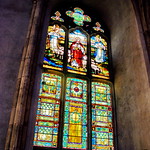
Life on the home front could not have been going too well, either. In 1910, Mattie and the children are all at home, according to the census. Mattie may not have been well, because in 1911, she died. Services were probably held at the First Congregational Church, the oldest continuously-operating protestant church in Southern California. Located in 1911 at Hope & 8th Streets, the main sanctuary held a stained-glass window now used in the Shatto Chapel at its current location of West 6th and Commonwealth. We know this because part of the stained-glass window in the Shatto Chapel holds a memorial to Mattie (the pane devoted to her is at lower right in the window).

Newton returned to his roots as an attorney (and most likely an apartment landlord too). In 1915 he is noted as law partners with his son Carl, who had just obtained his law degree from USC, and living on Wilton Place. But the State of California does not show Carl was ever admitted to practice. By 1918 Carl has moved into an apartment at 3553 White House Place (which has changed street names from Grove Place). By 1920 Carl disappeared from L.A. directories.

The probability is strong that Newton developed the quadriplex apartments along White House Place, due to his long-time living on the street, along with his children taking up residence there. The aerial photo below shows the area in the mid 1920's. A second house has appeared behind the residence at 3507, along with an apartment building to the east of 3507.

Bimini Baths ca. 1925 with
3507 White House Place in view above left
(with roof deck still intact)

Newton and Jeannette on their
passport application 1922
By 1920 Newton has moved out of 3507 and is living in the corner apartment at 3557.  In 1922 he remarried and took a round-the-world cruise with his new bride Jeannette. According to the passport application, they were using Raymond Whitcomb Tours, a major provider of the day. Upon their return, they settled in at 3557, while 3507 (which was now known as 3527 because of the new apartment building to the east) was rented to various people, including lawyer Leonard Thomas (1926), who worked in the same building that Newton had worked in in 1910, and doctor Louis Wyckoff (1930).  Around 1925 the Skinners themselves changed apartments in the same 4-plex, now taking up at 3555, where they remained until Newton's passing.

During the late 1910's and 20's neither daughter Emma nor Gladys can be found in the directories, but in 1932 a change occurred. Jeannette is listed as a widow, still living in 3555, which will be the last mention for her in the apartments of White House Place; and in 1936 a new resident, Miss Orine Emerson, is living at 3555. And in the same building at 3553 we now find younger daughter Gladys, who has married and resides with Mr. Claude Puryear.


White House Place ca. 1929
In 1942 the elegant house begins a new career. Called the White House Sanitarium, it is listed in the 1951 Sanborn map as a "Rest Home". A check reveals that the Sanitarium remained in use through 1965. It disappears in 1967, with no phone listed at that property. Gladys passes away in 1980, and in the next phone book available, there are no listings for the apartment building or the sanitarium addresses.

In 1992 the L.A. Unified School District made purchases on the block, starting up the "White House Place Primary Center".  By 2008 they owned all of the north side of White House Place. Then in 2007 LAUSD contracted for a hazardous materials report for the area. It was entitled..."PHASE I
ENVIRONMENTAL SITE ASSESSMENT
CENTRAL REGION ELEMENTARY
SCHOOL #20, SITE 1 (CRES #20, SITE 1)
108 SOUTH BIMINI PLACE
LOS ANGELES, CALIFORNIA 90004" .

Four hundred fifty pages long, the document listed much of the area's history, along with the contractor's efforts to determine if there were any hazardous substances on the property. Nothing significant was found, so the district went ahead and razed the structures and built a very nice parking lot, which just happened to be directly across the street from Virgil Middle School. No elementary school in sight just yet.

Thanks to Newton Skinner for his house photo--another element of Los Angeles now gone.
Today's aerial view of White House Place

More info:
A  visit to the All Night and Day Bank

Newton Skinner in 1910


Friday, January 25, 2013

Samuel I. Merrill -- 669 South Union Ave.

In 1900 the census stated that Jeremiah (Jere) B. Badgley (b. 1846) was a traveling salesman, living in San Diego. Not just any traveling salesman, as there was a servant in the house. By the next year he had transferred to Los Angeles, moving to Bonnie Brae Street with his wife and three children, working for M.A. Newmark, the largest wholesale grocery in California. Then in 1904 he moved into a new family house at 669 South Union Ave. Daughters Clara and Cecil held and attended card parties, participated in society balls, and generally enjoyed the society life of Los Angeles. Then in 1908 the family moved on to the new Westside, settling at 1245 St. Andrews Place.

Samuel in 1909
The next purchasers were Samuel (1856-1932) and Sarah (1857-1921) Merrill.  Samuel had come to California as far back as 1876, then to Los Angeles in 1881, where he started a hardware business, Merrill & Babcock. The next year he was a leading organizer of the Los Angeles YMCA, and was installed as its first president, serving for four years. During his time in Southern California he helped start Baptist College, the Union Rescue Mission, McKinley Industrial Home and the New Testament Church of Los Angeles, among other charitable pursuits. Businesses after his hardware store included Director, Western Gas Engine Co., Merrill Oil Co. and Merrill-Jensen Land Co. A member of the Chamber of Commerce in 1908-1909, he traveled to Japan, China, and the Phillippines with four others to report on trade there.

The Merrills were parents of two sons Wallace (b. 1893) and Charles Arthur (1890-1977), and a daughter Grace (b. 1889). In 1910 both sons lived at home, working for their father at a rolling mills factory.

669 South Union Ave. in 1909

In late 1914 the Merrills pulled up stakes and moved to Rio Bravo, a small settlement west of Bakersfield. Sons Charles Arthur and Wallace followed. All were listed as farmers in the 1920 census. Sarah passed away in 1921, and was returned to Glendale for interment.  In 1932 at age 75, Samuel died from an auto accident, and is buried beside Sarah at Forest Lawn.

Meanwhile at 669 S. Union, many tenants passed through the house.  Christian Science practioner Lillian Ruddick in 1915 was followed by Clyde J Cheney (1916), Albert J. Klunk (1917), and Arthur G. Reis (1921).

The area was going multi-family and in 1929 the new President Apartments were built, replacing our dutch colonial and the house to the west (at seen at left in the photo above).  In 1930, the census listed over 130 people in various apartments at this address.


The President at 669 S. Union ca. 1935
(courtesy of USC Digital Collections)

The apartment building still stands on the corner of Ingraham and Union, though Ingraham has been closed for many years, and is used mainly as a parking lot for the area. Today it appears from an aerial view of Google maps that there is no single-family house within two blocks of the building.  Two large, expensive-looking public schools reside to the east and west of the apartments.

Aerial View today

A big change for 100 years.


Tuesday, January 8, 2013

Dr. Leon Elbert Landone -- 2054 Holly Avenue

It was quite a house...built on 15 acres, definitely out of town...then. Articles announcing the new home mentioned it was "a couple of blocks east of Vermont near Los Feliz Road," which was just east of as yet undeveloped Laughlin Park. The house itself was built in 1904, and was a definite showplace for its first owner, William H. Hoegee.

A postcard of the house in a 1905 photo

Here is how the L.A. Herald described the house.

 "Across the west front and along the sides of the two-story residence is a wide veranda bordered with columns and arcade effects. The first floor has a wide reception hall, a large living room, a dining room and breakfast-room, and at the rear of the living room is the conservatory, also a den, a diningroom [sic] and the usual conveniences for home life.

"On the second floor are six large bedrooms, with dressingrooms [sic] and baths. From the second floor a broad stairway leads to the roof garden. The residence is supplied with furnace heat and a private gas plant."
1898 Hoegee ad in the L.A. Herald
(courtesy of cdnc.ucr.edu)
Hoegee was a successful sporting goods dealer--his family was well known for its camping gear, especially tents, operating on South Main St. in central Los Angeles. The company still survives today, albeit in Gardena instead of downtown Los Angeles, and they concentrate on custom awnings, but early ads for their tent products can be seen on their website. Not too many companies in L.A. alive today can claim they started as early as 1886.

In March, 1907 a series of small weekly ads appeared in the Herald. They were all similar in character and style, and mentioned of lectures by a Dr. Leon Elbert Landone (1857-1945), "an English scientist and brain building specialist." He was beginning a "course of three lectures on Awakening Man's Dormant Brain Centers and Unconscious Possibilities. ", speaking each Thursday and Monday throughout that Spring at the Auspices Metaphysical library, 611 Grant bldg., course ticket $1.00, single admission 50 cents. He also advertises other lectures, including The Works of Luther Burbank, Do We Know Just What the Soul Is?, and Cosmic Consciousness.  Those small, classified ads were the very first mention of Dr. Landone. Searches of earlier publications in California and other states, as well as census records failed to turn up a Dr. Landone, or a Leon or Brown Landone, in either the U.S., Canada, or England.

Another photo of the Hoegee Mansion

A close-up of the house from the photo above

The lectures must have been a success, as he took them on the road, resulting in multiple mentions in local papers. By November he had shifted gears, speaking of the value of Luther Burbank's new spineless cactus, which would provide great fodder for cattle. Next month he was back in L.A. touting his new spineless cactus diet, which was based on a new cactus variety (and for which he had purchased ownership rights to). He received notice in the papers on this in both San Francisco and the Imperial Valley. A third article mentioned his plan to climb Mt. Wilson as exercise while on the diet, as he had kept all his energy.

His fame expanded. In January, 1908 he spoke as an invited science lecturer to a meeting of the Ebell Club of Los Angeles, speaking on the topic Individual development through vibratory processes--tone, color, electricity and thought.

Then in May, 1908 came the big announcement.


Making two consecutive days with front page headlines, Landone announced his purchase of the Hoegee Residence, including the acreage, for his great experiment in a "proposed school of evolution and institute of child culture. Children will be selected from various centers throughout the United States, and these will be used as the subjects for evolutionary experiment." He was further quoted "[These children] will be simply the examples of the best physical body combined with the best mental qualifications", while purposefully disavowing the use of "artificial marriages". He mentioned his independent study abroad "for years, at such institutions as Padua, the University of Paris, at two or three English institutions of learning" and went on to state "what was of more value to me than all the rest combined [was my] three months of study under Herbert Spencer."

In January, 1909 it was announced that Dr. Landone had returned from his trip back east, and selected twelve children "upon whom to apply his theories of race development through the improvement of the individual." It was also announced that Dr. Landone had personally assisted in the selection of tints for the bedrooms in the extensive remodel of the house.

Dr. Landone in 1910
(photo very similar to the 1908 one?)
By now he had caught the eye of Lillian Baldwin, widow (as of March, 1909) of early L.A. pioneer E.J. "Lucky" Baldwin (of Santa Anita and L.A. Arboretum fame), and who held a strong interest in this method of teaching children. In June the New York Times mentioned a rumor of marriage between the two, which was not denied by either party. The article noted "The couple have appeared frequently at musicales together, and Mrs. Baldwin is always one of the guests when Dr. Landone entertains at his big home."

But he did not marry, for in 1910, the federal census noted Dr. Landone as single, and living in the house at 2054 Holly Avenue with a housekeeper, a gardener, a chauffeur, and a maid. His occupation was recorded as general lecturer, age 52, born in Canada, father born in Wisconsin, and mother born in New York.

And for the Burdette book of 1910, he is more than a "general lecturer", he is now degreed with an A.M., M.D. PhD. Usually below the photo of an entry in the book there would be a short biography, showing the background, schooling, work experience, and typically the spouse of the entrant.  Interesting reading, though, for Dr. Landone's entry. Past locations for him are non-existent. He is noted, however, as being "Executive Secretary International Committee of New Educational Movement and President Institute of Applied Science and Art." No mention of where his degrees are from, however.

The house in its 1910 glory
Sometime in 1911, Dr. Landone left--a D.A.R. book from 1911 listed Mr. & Mrs. J. Edward Fairbank as now living in the house. An article about an art colony in New Hampshire appeared in Harper's Weekly that year and was authored by a Dr. L. E. Brown-Landone, the first mention of the name in print. By 1915, Dr. L. E. Brown-Landone made accusations from France about the American Red Cross being influenced by the Germans. He returned later that year to New York 20 years younger than when he left. In 1918 Leon Elbert Brown Landone, a lecturer, resided in Queens. In 1920 Brown Landone, a book editor, was found by the census renting in Queens, New York.

By 1940 Brown Landone had moved to Winter Park, Florida, and was noted as a health author in that year's census. He passed away in 1945, and is buried in Palm Cemetery in Winter Park.

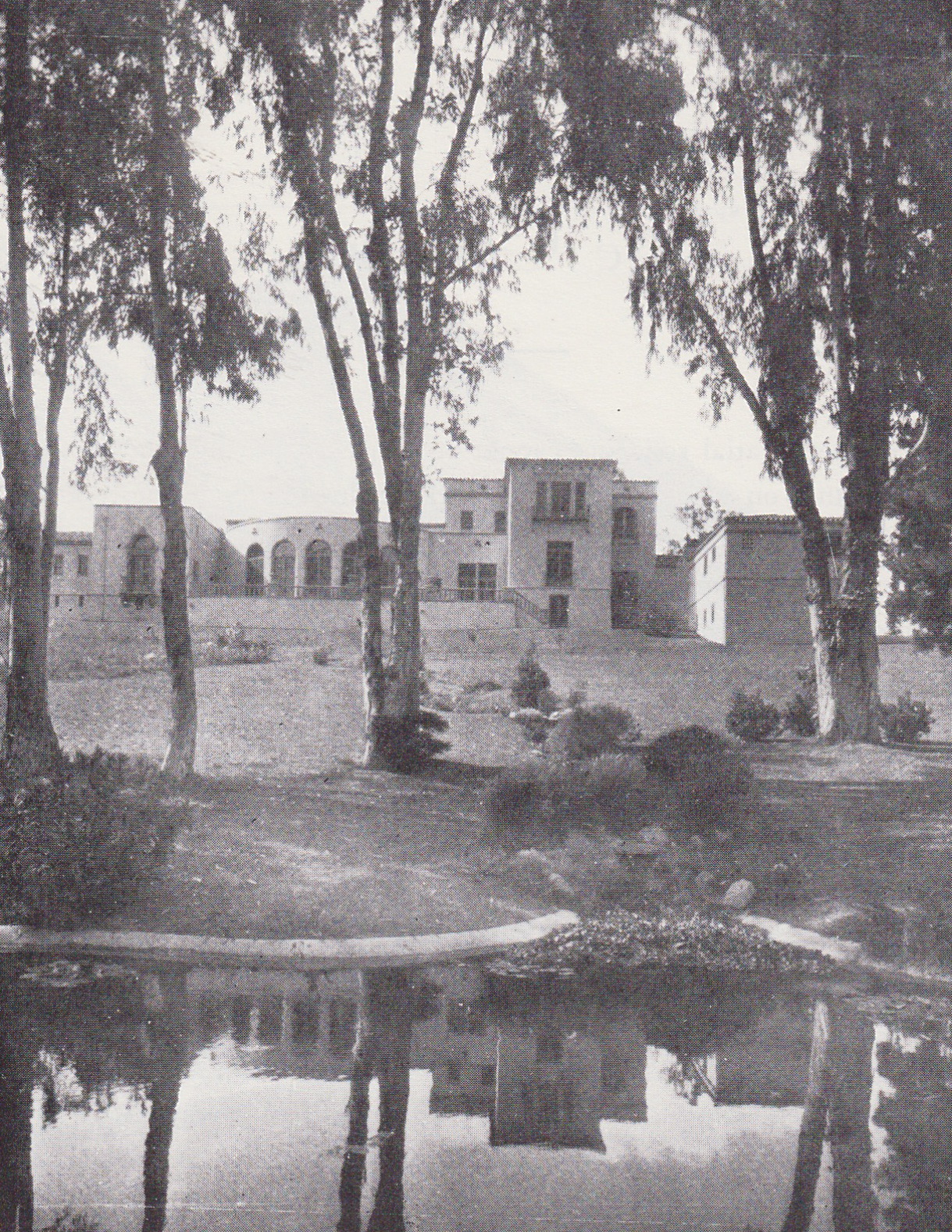
After 1911 the house's residents become fuzzy. With the large property surrounding the house, the potential resident pool was no doubt small. By 1919 the house had changed addresses, becoming 2124 North Commonwealth, and in 1923 it was occupied by Hollywood director Maurice Tourneur. The next recorded mention of the property was a sale in 1927 by John H. Fisher, a noted real estate investor, to the Bank of Italy, who subdivided the acreage. The main house area was then purchased by Phillip and Frances Hunt that same year, and the Hoegee house was demolished to make way for a new residence. (Others have made statements that Tourneur built the current residence.) In 1928 the house, now known as The Cedars, was inhabited by actress Madge Bellamy, who interestingly was the star of a Maurice Tourneur film of 1922, entitled Lorna Doone.  Two early photos of the much larger house seem to be available on the web. One is shown below.
courtesy of michaelgankerich.wordpress.com

Following Ms. Bellamy's stay it has been the home of multiple business persons and Hollywood personalities, culminating with Sue Wong, fashion designer, who purchased the property around 2004 and restored it.

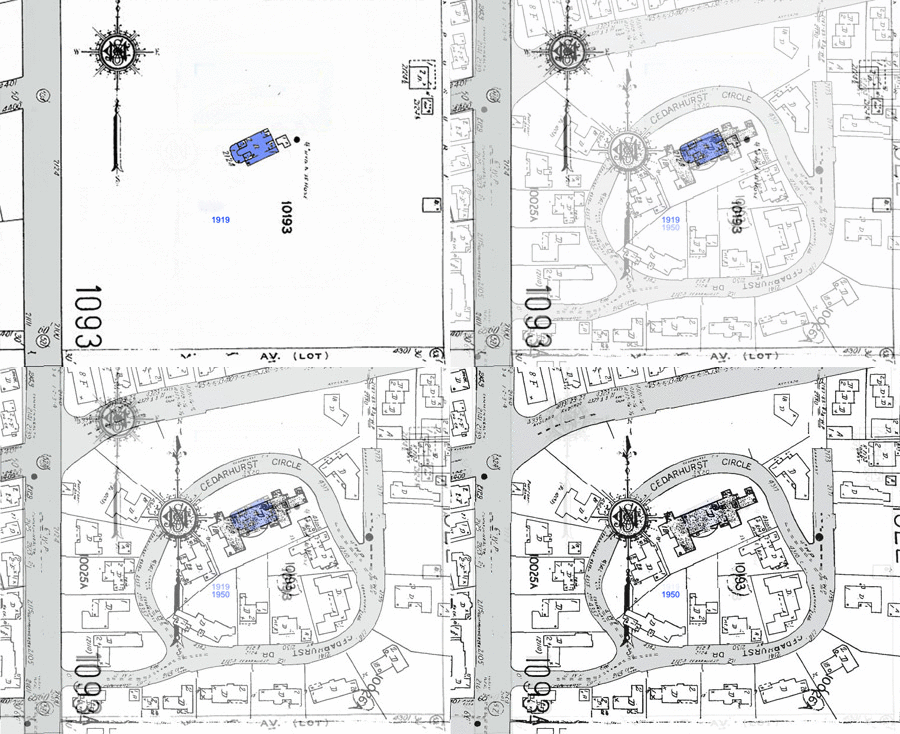
With the assistance of Sanborn maps and today's technology, it is possible to view the acreage change from 1919 to 1950. Cedarhurst Circle outlines the hill.


Animated map showing from Landone Park to The Cedars

Today's address for the site of the old mansion is 4320 Cedarhurst Circle.


More Information:
Further reading on Brown Landone
A few books written/published by Dr. Landone
Los Feliz Improvement Assn. info on Hunt house of 1927

Developer Xorin Balbes--the owner who sold to Wong


Updated 12/28/17

Saturday, December 29, 2012

Gilbert D. Munson -- 2717 West Eighth Street

Gilbert Dwight Munson (1840-1911) traveled to Southern California in 1900 after a successful career as a judge and lawyer in Ohio. Upon arriving he joined up with local lawyer Henry A. Barclay (who got him admitted to practice law in California) and hung out his shingle as the firm Munson & Barclay, specializing in civil matters in superior court. Coming to L.A. with Gilbert were his wife Lucy (who went by the name Lulu)(d. 1926) and only child Sarah(d. 1911), who married an old flame from Zanesville after returning there to help him heal from a lingering sickness. They came back to California and settled first in Los Angeles before moving to the Santa Barbara area.

L.A. Herald, Oct. 1903
By 1903 things were going well as can be seen by the notice at right in the Los Angeles Herald of a new Munson house to be built out on West 8th St. The $3,700 planned price tag works out to be around $95,000 in today's dollars. It appears that real estate in L.A. was a good bet even then. Houses in the same block today are valued in the $700K range according to Zillow.com.

Sarah and Lulu joined in the society of the times--in one article they were noted as signing up for annual dues to the new Children's Hospital. Other donors included Arthur Letts, Niles Pease, Mrs. W.C. Patterson, and Mrs. Homer Laughlin.

Below--a photo of the house ca. 1910:

The Munson Residence in 1910

Sadly, Gilbert passed away soon after in May, 1911. His law partner Barclay continued his practice after that alone. Then in October another death--daughter Sarah dies, leaving three children with husband Ernest.

Gilbert in 1910
By 1913 Lulu left the house, moving to then Santa Monica, now Brentwood (quite out of town for the day), settling in on Cliffwood Drive. The 8th Street house was then rented for awhile to Moses P. Brown and family, a bookkeeper at the German American Trust and Savings Bank.

Supposedly Ernest came from an upper-class background in Zanesville, but his relationship with Lulu didn't seem to be a great one, as in May, 1913 a judgment against him is posted in the Oxnard Courier followed ten days later by a notice of him transferring a 1/4 interest in a large acreage in the Montecito area.

In 1926 Lulu passed away, and was buried with Gilbert back in Zanesville.  Daughter Sarah, husband Ernest, and their three children were all buried in Santa Barbara.

And the house on West 8th Street?  It disappears from the listings after 1915, and when the area next showed up in a 1951 Sanborn map, the corner east to Hoover including the Munson lot is a commercial L-shaped retail area, as it appears today. And here's a look courtesy of Google:

The "Max" sign is where the house had been.

More Info:
G. D. Munson Biography

Sunday, December 9, 2012

William S. Bartlett -- 2400 West Adams Street

Golden Spike, gift of David Hewes
to Stanford Univ.
When William (1844-1915) and Franklina Gray Bartlett (1855-1934) moved to Southern California in 1881, it was for a common reason--warmer climate to improve health. But it wasn't for them.  Franklina's mother Matilda Gray Hewes, suffered from bronchitis. She arrived first with husband David (Franklina's stepfather)  and settled in Tustin.

David Hewes was a successful capitalist, well known in San Francisco.  Good friends with the Big Four of California railroad fame, he was originally offered a chance to participate in the transcontinental railroad, but he dismissed it as "too risky". He did however, celebrate the railroad's success, providing the golden spike for the railroad meeting ceremony in 1869 in Utah. When the spike was cast, the "sprues" (leftover metal edges) were used to create souvenir gold rings, one of which passed down to Franklina after Matilda's death in 1887.

Franklina Gray Bartlett, 1876 William Bartlett, ca. 1881
Upon Matilda's death David returned to San Francisco, and subsequently married again to Anna Lathrop, sister-in-law to Leland Stanford. Tragically, she passed away in the mid 1890's, after which David returned to Orange County and created a large citrus ranch, which he ran until his death in 1915 at 93 years of age.

While in Tustin, Franklina started the Ebell Society of Santa Ana Valley, modeling it on the Oakland society, where she was its first president. William continued with his banking career, starting multiple banks in Orange County, including the Bank of Tustin. Both were involved in the local Presbyterian church, where father-in-law David had donated monies for a new building. The Bartletts knew the pastor James French well, as he was related to Franklina. By 1898 the Bartletts moved to Los Angeles, first settling at 322 W. 27th Street with their three children Lanier (1879-1961), Matilda Franklina "Lina" (b.1886), and Gordon (b.1894). William worked downtown as president of the Union Bank of Savings, which was easy to reach on the West Adams St. Line to downtown ending next door at Arlington and West Adams.

In 1904 the Bartletts moved west to the city limits, out on fashionable West Adams.  Across the street in the brand new neighborhood were the Fitzgeralds, while directly east was the Childs family, and Dr. E.A. Bryant, chief of L.A. County Hospital surgery, to the west. Their property on the south side of West Adams sat on a ridge with an excellent view south to the bay.

West Entry Drive to
2400 West Adams (later 3200) ca. 1910

German-American Bank
W.S. in 1903
Soon after moving into Fenton Knoll (as it was named), William's bank, the Union Bank of Savings, was merged into the German-American Savings Bank. William continued as president of the  combined institution. The bank closed the old German-American location, and continued to do business at the Union Bank location at 4th and Spring Sts., albeit with a new, large sign (see postcard image).  The bank continued to grow, and by 1912 they had leased space in the new A. G. Bartlett building at 7th and Spring Street. A.G., not apparently related to William, made a lot of his money in the music business, which is chronicled in an article about his successor, John Fremont Salyer.

By 1910 son Lanier had struck out on his own, moving to the Hollywood area where he became a successful writer. His best known work, Adios, authored with his second wife Virginia Stivers, was made into a successful movie in 1930, entitled The Lash, starring Richard Barthelmess and Mary Astor.  The rest of the Bartlett family (W.S., Franklina, Lina, and Gordon) celebrated with a round-the-world cruise, which began in February in San Francisco on the S.S. Cleveland.

East Entry Drive ca. 1912
(courtesy USC Digital Archive)

Lina in 1908
Sadly, in October, 1914 the Los Angeles Times reported William's "sudden death" on Saturday the 10th. A funeral was held on the 12th at the West Adams Presbyterian attended by "many neighbors and friends". It was reported that William left most of the estate to Franklina.

One of the "friends" attending may have been James H. (Jim) French, son of Reverend Junius French from the early days in Tustin, who was in fact a second cousin of Lina.  Jim was listed as a teller at the German-American Bank in 1915, and the directory showed his residence as one and the same as Franklina and daughter Lina.

Jim went on to marry Lina later that year, with the wedding and reception taking place in the rear garden at Fenton Knoll. With Jim's father Junius officiating, the family captured the moment on film and we are fortunate to present a brief video of the event below.


In the late 1910's son Gordon perished in a drowning mishap. Son-in-law Jim became an auto dealer.  He and Lina are still in the house with Franklina and house maid Anna Zackrisson (who was listed also in the 1910 census). In 1929 James is listed as an insurance agent. Their children Franklina (b.1921) and James H. Jr.(1924-1944) have now joined the family--and of course Anna is still there.

On Christmas Eve, 1934, Franklina died. The house ended up with Lina and Jim, who continued to live there with their children and Anna. The 1940 census now showed Jim's occupation as a real estate broker. That may have been because in 1941, the house was sold, and the Frenches moved to Santa Monica.  The buyer was the Armenian Apostolic Church, which named their new church St. James.

The parish dedicated a new sanctuary building in December 1957, which could be used as an unofficial end date for Fenton Knoll.
The new sanctuary ca. 1958 for St. James

In 1963 the church sold and moved to new quarters on Slauson Ave.  The buyers were the Apostolic Faith Home Assembly Church. 

A not-too-far-in-the-past shot of the property at 3200 West Adams
A large addition in the back lot stretched the church financially, resulting in the eventual purchase for its current use, Frederick Douglass Academy High School, as an effort by the Los Angeles Unified School District (LAUSD) to improve education results through the use of charter schools.
The Frederick Douglass school closed in June, 2015. It became a LAUSD charter school focused on math and science preparation.

A 2018 photo of the school (courtesy of Google Maps)

More info:

1903 biography on Mr. Bartlett

Link checked 8/29/18