Showing posts with label Pasadena Residence. Show all posts

Saturday, June 22, 2013

Robert & Clara Burdette
891 S. Orange Grove Blvd. Pasadena


Today's blog entry was not chronologically the last house photo in the book used as the main reference for these entries.  In fact, it was the first one, as it was the home of the book's editor Robert Burdette. Both he and Clara had short biographies posted (see more info at bottom). All the photos of houses have been posted except for the Burdettes.  It's been enjoyable to take these many trips back in time, finding out interesting stories about early Southern California personages.


In 1890, Colonel Presley C. Baker (1838-1893) married Clara Bradley Wheeler (1855-1954), after the death of her first husband. Colonel Baker had moved to sunny Southern California in the early 1880's for his health, as he had been afflicted with Bright's disease.

In 1892, they had constructed a new house in Pasadena along Orange Grove Boulevard.  The home was not overly ostentatious, but was excellently sited on a large lot with an extensive view both east and west. Sadly Col. Baker died the next year, and so was unable to enjoy much time in the new home. Mrs. Baker remained, however.

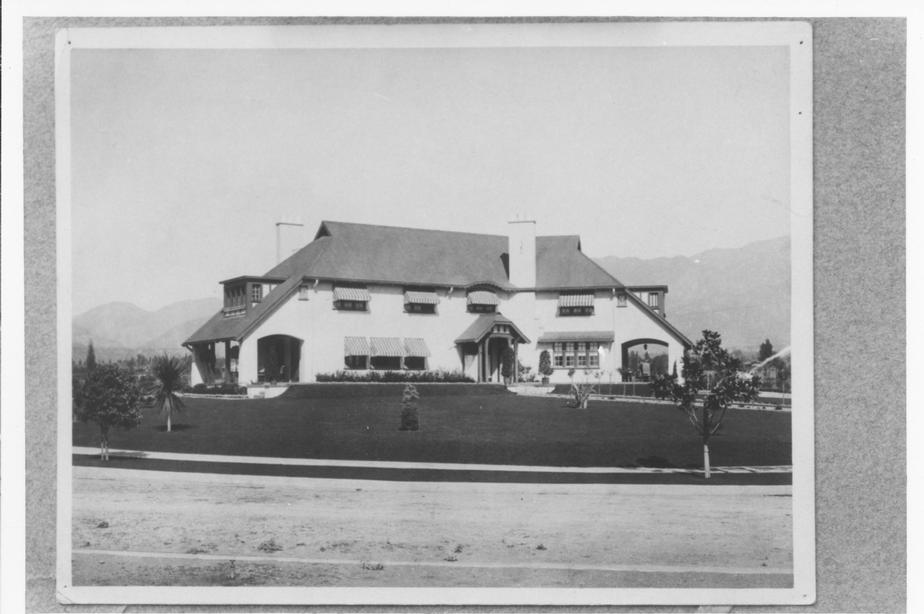
The House in 1899
(courtesy of American Architect, Feb. 1899)

With her sizable inheritance from Col. Baker, Clara remained active in her philanthropy and social work.  A founder and supporter of Alpha Phi Sorority while she was at Syracuse University, she also organized the Southern California Branch of the Assn. of College Alumni and was its first president. She was also a life member and founder of the Los Angeles Ebell Club.

In 1899 she remarried, this time to Robert Jones Burdette, a successful minister ordained in the Baptist  Church, who was well-known for his many entertaining lectures around the United States. Clara and Bob (as he was known to his friends) had met early in life when both were back east, and notice of their marriage was news to more than just local friends. The San Francisco Call featured them in an article, for example.

After the marriage, he moved in to SunnyCrest, as the house was known, where in 1900 the census found him along with Clara, Clara's mother Laura Bradley, Clara's son Roy Wheeler, and a housekeeper.
The House in 1900
(courtesy of USC Digital Collections)

Bob remained on the lecture circuit, although he took a temporary minister position in a Pasadena Presbyterian church for three months after the marriage. Meanwhile Clara continued her work in women's rights in the L.A. area. But as time passed Bob eventually took the position of pastor at the Temple Baptist Church in Los Angeles, to cut down on the travel, no doubt.

Clara in 1905 for an article
about the Ebell Club
In downtown L.A. in 1904 the largest venue for gatherings was the three-storey Hazard's Pavilion, which could seat about 1,200 patrons. Built in 1886 by Henry Hazard, it had been used for everything from fairs to boxing matches.  In the fall of 1904, Temple Baptist Church leased the facility with a primary purpose to hold Sunday services. It was renamed Temple Auditorium and sermon attendance at the pavilion immediately overflowed capacity. The inadequacy of the facility was reinforced when the Ignace Paderewski Concert of New Year's Eve 1904 couldn't start on time due to crowds thronging around the small building entrance. A week later complaints were made to the city council calling the place a firetrap. The following February speakers Madame Melba and Dr. Wilbur Chapman caused multiple, overflow crowds.


And so it was inevitable that in February, 1905 a new company was formed for the creation of a new auditorium on the corner of Fifth and Olive Streets, to seat 5,000, six storeys in height. Among the directors of the new company? W. C. Patterson and Clara Burdette. By November, 1906 the new Temple Auditorium was now complete, and constantly used by the Temple Baptist Church. In 1920 the Philharmonic Orchestra moved into the building causing a name change--to the Philharmonic Auditorium, which was a name known to many thousands of current Southern Californians, who traveled as youngsters into downtown Los Angeles to see all the big musical events before the creation of the Dorothy Chandler Pavilion in 1964.

Meanwhile the house was featured in a 1903 book extolling the features of Pasadena.

The House in 1903

Then in the 1904-1906 time period a large addition to the south side of the house occurred. It is easy to see below. And the fame of the owners brought publicity to the house via the new tourist item, the postcard.

SunnyCrest after the addition

Postcards of the interior were not left out, either.
Reception area of SunnyCrest
The library at SunnyCrest

Bob remained as pastor at the Temple Auditorium, and in early 1909, while preparing for a trip back east, he fell while in the house and injured his back quite severely. Clara, in attempting to care for him, became seriously ill herself in May, lapsing in and out of consciousness. By August the seriousness of Bob's injuries became public as the Temple Baptist Church announced that Bob had resigned. His doctors had concluded it would be many months at a minimum before Bob could possibly return to the pulpit.

During this time period, however, he worked on his book about prominent Southern Californians.  Here is the picture he chose for SunnyCrest.

Our book's photo of SunnyCrest in 1909/1910

By November, 1909 he and Clara had both improved, and he returned to the church pulpit as pastor emeritus, saying goodbye to his congregation, notifying them of family plans to take a trip to the Far East.
SunnyCrest in 1912

By 1912 Bob's health deteriorated to where he could no longer publicly speak, and in 1914 he passed away.


Clara remained  in the house until 1919, when she sold the house and retired to Pasadena's Hotel Maryland. In 1922, at the urging of many friends, she wrote a biography about her late husband (from which the above photo was found). From 1930 on she resided in the Hotel Huntington, passing away in 1954.

The 1919 buyers of Sunnycrest were Thomas and Nettie Warner.  Thomas had recently sold his auto steering and transmission parts company of Muncie, Indiana to General Motors, retiring then to beautiful Southern California. By now an auto garage (guest house) had been added out back. Then in 1926 Nettie decided to raze the house and erected a new house on the property. She and Thomas remained there--he passed away in 1947; she stayed on until her passing in 1962. The property was then redeveloped as apartments.  The former garage appears to be the same one--at some point it appears to have been sold to the property owner to the west. No vestige of the former Sunnycrest house remains.
Today's street view

Below is an overlay of the 1910 Sanborn map with today's aerial view.  Notice the suspect garage in the lower left.

Today's aerial view of the former SunnyCrest property. Orange Grove Blvd. is at right.

Further information:


Note: When you first land on this blog, the comments do not appear, and the post title is the color red.  Click below on "comments" to see them, or click on the post title, which turns black, and shows the comments.

Friday, March 15, 2013

George R. Davis -- 400 N. Madison, Pasadena

Born in Huntsville, Ohio, George Davis (b.1861) obtained a law degree and settled in Tucson, Arizona Territory. By 1895 he was married to Katharine Scovil, with children George Russell, Jr. (b. 1891) and Florence (b. 1896), and appointed to the supreme court of Arizona. Re-appointed in 1901 by Pres. Roosevelt, he served until re-settling in California permanently in 1905. He practiced law until 1909, meeting those in Southern California politics along the way. One of those he met was William H. Vedder, former mayor of Pasadena, and in 1907 Davis purchased the Vedder home at 400 N. Madison, which was chronicled in this blog back in early 2011.

400 N. Madison under ownership of W. H. Vedder (ca. 1906)
In 1910 the census showed George and Katharine living in the house, as well as George, Jr. and Florence. Joining them were two more siblings, Frances (b. 1901 CA), and Helen (b. 1903, CA) along with Florence's father and a maid named Ida.

In 1909 George was appointed to the Superior Court Bench of Los Angeles County, which was followed by his election to the post in 1910.  He continued as a judge for the next 20 years.

The house under the ownership of George & Katharine Davis (ca. 1909)
The family remained in the house through George's passing in 1932-1933 timeframe. California voter rolls in 1934 show Katharine, George Jr., along with daughter Frances living in the house. By 1940 Katharine remained but was then living with her two older unmarried sisters, Josephine and Jessie Scovil.

Katharine died in 1943. The property, large and centrally located, was redone with twin apartments, which are there today.

Today at 400 N. Madison (courtesy of Google Maps)
While there is another instance of the same house in different editions of the original book used for this blog, this one is unusual as BOTH men are listed in the same edition.

A photo of George in 1910

Sunday, October 7, 2012

Richard V. LeGrand -- 149 N. El Molino Ave., Pasadena

Richard Virginius LeGrand (b. 1860 TX), after attending Georgetown College in Washington D. C., pursued the mining business for 20+ years. With a large silver vein coming in at the "Mountain King" mine in the Lucky Boy, Nevada area, he decided to leave Texas and settle in Los Angeles, where he formed the Alamo Mining Co. to work various mine properties in Nevada, Arizona, and New Mexico.

The family settled in Pasadena around 1906, purchasing a home just a block north of Colorado Blvd. The 1910 census showed quite a crowd at their new Pasadena house. Along with wife Dixie (b. 1863 AR), many of their seven children lived with them, along with a few grandchildren. The house's occupants included son Joseph (b.1886,  TX), his wife Ethel, and their granddaughter; son George W. (b.1890 TX); son Richard V. (b. 1893 TX); daughter Edith V. (b.1896 TX); daughter Annie W. (b.1899 TX); daughter Myrtle N (b.1904 TX); and Dixie's older sister Georgie. No doubt the large number of people in the house was a premonition to its major use later in life.

149 North El Molino in 1909
  It appears that R.V. had everyone who was at home come out on photo day.  Here's a close up of the front porch.

Picture Day
From left to right a guess of the family would be Dixie, Annie, Richard Jr., Edith, R.V. holding granddaughter Heriot's hand, and Myrtle sitting on the step.

But Pasadena was unable to keep the LeGrands and by 1915 the family had packed up and moved to West Adams, moving in at 640 West 21st St. The street directory for that year, which only recorded adults, showed that along with R.V. (and presumably Dixie), sons Claude, George, Joseph (now known as J. Mastella), and Richard V. were in residence.  R.V. was listed as a mining engineer. The family moved again by 1920 to 2118 Oak Street, where ten people were recorded for the 1920 census.

Clinton C. Clarke
(original fm pcta.org)
Meanwhile back at 149 El Molino, the Jay C. Hills family had moved in, seeking relief from Chicago winters.  Their son Gerald attended Occidental College, while spouse Myrtie was a member of the nearby Shakespeare Club, where she no doubt knew the B. O. Kendalls, who lived next door to the Club. By 1930 the Hills had moved to the new Vista Del Arroyo Hotel overlooking the Colorado Street Bridge.

Interestingly it was also the home of Clinton C. Clarke (1873-1957) and his wife Margaret, who were soon to be involved with the El Molino property, which by now had become the Altadena School for Girls, a private boarding school that listed two teachers and five students in residence in 1930.

Clinton C. Clarke was listed as "retired" in the 1920 census, when he was 46 years of age. In 1910 his occupation was "own income". It appears inheritances from his Chicago lawyer father and his mother's family allowed Clinton to pursue his own agenda. A recorded lawsuit in 1898 appears to have provided 2/24ths of his mother's father's estate, which was ample.  He married Margaret in 1906, and from 1920 on, they lived in hotels.

In 1924 the Pasadena Playhouse built their historic building at 39 South El Molino, just two blocks south of the  house. While Clinton was its first President and on the founding Board of Directors, Margaret was keenly involved with the Playhouse too, as indicated by numerous articles in the Pasadena Star-News of the '20s and '30s. One 1926 headline stated:

"'You and I' is poignant comedy : Margaret Clarke, Samuel Hinds, Lois Austin and Maurice Wells lead : Are favorites at Playhouse : Credits charm of new production to skill of entire cast"

 By the 1930's the Playhouse was a major force in Southern California, attracting would-be actors in droves. In order to house the many students wishing to participate, the Playhouse purchased three houses on El Molino Ave. and named them in honor of their major patrons.  One of these places--149 North El Molino Avenue --was appropriately named "Clarke House", and was a female dormitory through the early '50s, before becoming mixed in the 1960's. Actress and former Playhouse student Joan Taylor, who was in the movie Rose Marie and TV's Rifleman series, stayed in the houses during her early career. Here's an excerpt from a 2007 interview with her discussing the topic of Playhouse dorms:

"It was very special. I lived in a Playhouse 'dorm', an old Pasadena house that had been taken over by the Playhouse; there were two or three of these marvelous old homes that they took over."
USFS Plaque
for Clarke
In addition to supporting the Playhouse, husband Clinton had a love of hiking, and is given credit for first proposing the Pacific Crest Trail in 1932. Along with sponsoring multiple activities supporting the trail, he also advocated politically for the trail, continuing until his death in 1957, twelve years before the actual designation. In honor of his long-time efforts, a plaque was placed by the U.S. Forest Service in Soledad Canyon along the trail in 1998.

By the end of the 1950's, the Pasadena Playhouse was slipping, as evidenced by its 1963 sale of the three dorm properties to supporters, and then leasing the properties back from them. After founder Gilmor Brown's death in 1969, the Playhouse entered bankruptcy. Clarke House was in the hands of Playhouse supporters, but ultimately all three houses (127, 139, and 149) were demolished, resulting in the building and parking lot of today.

Approximate view of 149 N. El Molino today
(part of Ironworkers Office Plaza)

Additional Info:
Photo of R. V. LeGrand (1909)
Clinton Churchill Clarke obituary (1957)

Wednesday, April 25, 2012

Eugene E. Hewlett--1450 Hillcrest Ave., Pasadena

Frederick and Cleora Hewlett were listed as farmers in Petaluma in the 1880 federal census, but they must have been more successful than most. They were able to live in San Francisco, as well as retire after that in the Napa valley. Of their five children born, tragically only two would get past childhood--but they were both strong achievers. Eugene Elbert (1878-1946) was the younger brother of Albion Walter (1875-1925). Father Frederick moved to San Francisco when the boys were young, and they grew up going to San Francisco public schools.

Walter headed off to UC Berkeley for college, earning a B.S. degree in 1895, before advancing to Johns Hopkins University to become a doctor. With his MD degree in hand in 1900, he came back to San Francisco to teach at Cooper Medical College (today part of Stanford). In 1908 he took a position in Ann Arbor, Michigan where he joined the faculty at the University, and met his future wife Louise.

Meanwhile younger brother Eugene followed in Walter's footsteps at Berkeley earning his Bachelor of Laws degree in 1900, then headed off to Harvard for his LLB degree. It was there he became friends with Howard E. Huntington, only son of Henry E. Huntington, the latter of  Huntington Library fame. After graduation in 1903, Eugene returned to San Francisco to pick up the same law degree at Hastings, which would allow him to practice law in California, which is what he did shortly after being admitted to the bar, again in 1903. He set up practice with two other Harvard graduates, calling themselves Hewlett, Bancroft & Ballantine, with offices in San Francisco and Los Angeles. 


On October 20, 1904 the Society news in Oakland was
Oakland Tribune 22 Oct 1904
(courtesy of ccdn.ucr.edu)
abuzz with the marriage of Eugene to Ione Fore. The description of the event (along with photos of the bride and maid of honor) took eight column inches in the paper. Ione was described...
"The bride was simply beautiful. Miss Ione Fore has always been beautiful, at all times, and she was a royally beautiful bride. The gown was of white satin, the heavy effect relieved with the overdress of fluffy tulle, and over that was the filmiest of Bruges lace."
The article went on to list Eugene's best man--brother Walter, who assisted in the event along with ushers Allen Chickering, Thomas Bishop, and Howard Huntington.

The next August Howard had found his bride-to-be and the wedding with Leslie was a society event of the season. The stag dinner for Howard was held two days prior at the San Francisco Palace, and hosted by--Eugene Hewlett. No doubt Howard's money set a high bar for keeping up, but Eugene appeared to be staying in step.

The next year was a tough one for San Francisco, with the earthquake and subsequent fire eliminating large portions of the central city. Included among the victims was Mrs. Simeon Wenban, who'd lost her Van Ness Avenue mansion in the fire--as widow of Simeon, a very successful miner in Colorado, she was indeed wealthy, but had no ready access to cash. She needed assistance in getting the insurance to pay for her house, and her daughter Eva Shaw recommended her friend Eugene, which established the beginning of a long-term relationship.

By 1907 Eugene and Ione moved to Los Angeles, taking up residence in the stylish West Adams district on west 28th Ave. It was simple to do as the law offices just added a new office in Los Angeles. It was located in the Pacific Electric Building, 3rd floor, in downtown L.A. (which was owned by Howard's father...). Howard had moved from San Francisco where he had been working at the Southern Pacific Railway, to Los Angeles where he ran the Los Angeles Railway out of the same Pacific Electric Building. Howard and Leslie had located in his father's new Oak Knoll subdivision in Pasadena, which was about a mile from Henry Huntington's new palatial home in today's San Marino, and adjacent to the new Huntington Hotel.

Eugene and Ione quickly purchased a new lot in Oak Knoll, building their new home on a 10+ acres with expansive views of the San Gabriel valley, and moved in by 1909. Now the Hewletts were just up the hill from the Huntingtons.

1450 Hillcrest Ave. in 1909

The 1910 census described inhabitants as Mr. and Mrs. Hewlett, along with two servants, and two "hired men". Interestingly Mrs. Hewlett attended a family reunion in San Francisco two weeks prior, and ended up with the distinction of being listed twice in the census. And that same year Henry Huntington divorced his long time wife Mary, Howard's mother. The world was later to find out that Eugene took on the role of managing some of her money, too.

The Hewletts were a strong part of Pasadena's society.  One article in the Pasadena Star-News described Mrs. Hewlett thus:
"...Mrs. Hewlett stopped at Hotel Huntington last year and her costumes were the admiration and wonder of Pasadena's wealthy and the millionaires who came from the east. At the tango dinners where famous professional dancers performed, she was always the most brilliant in the throng and her appearance invariably excited admiring comments. Slightly built, with perfect features and dark hair, she was always gowned in the most dazzling creations and at the charity ball, where women brought their costumes direct from Paris for the brilliant event, Mrs. Hewlett in her attire always managed to outshine the others."
Eugene in 1910
As Mrs. Hewlett delighted society, Eugene immersed himself in his passion for race cars. No doubt convincing Howard to join him, they were partners in the Pacific Coast Motor Car Co., which gained dealer rights for Fiat on the west coast, including Seattle, San Francisco, and Los Angeles.  An office was opened in San Francisco. Eugene bought a Fiat racer in late 1910, and hired a driver, David Bruce-Brown. The Fiat had just come off some successful races, and it was expected to do well in future showings. With its 175 horsepower engine, it could sustain speeds of 75 mph, so with great anticipation Eugene entered the car and driver in the FIRST Indianapolis 500, held May 30, 1911. Lo and behold the Fiat finished third, entitling owner Eugene to winnings of $3,250.


Next year 1912 was even more successful.  Eugene, with a new
The 1912 Fiat Recently
driver "Terrible" Teddy Tetzlaff, placed the Fiat second at the Indianapolis 500, with an average speed of over 76 MPH, earning $10,000 for the finish. They were one of only ten cars to complete the full 500 miles.

The successes continued throughout the year, with a win in Tacoma at the Montamarathon--and a trophy to prove it.  This was followed by a win in Phoenix with Teddy again at the wheel. A great racing season for the team.

In 1913 racing continued with Frank Verbeck as the new driver. As a former chauffeur for Hewlett, he raced under the Pacific Coast Motor Car Co. banner. He won more than one race in which he beat the famous Barney Oldfield, including the 1913 Panama-Pacific Road Race, to the point that Oldfield purchased the Fiat for his own after the 1914 season.

But not all was wine and roses. It was reported that the house at 1450 Hillcrest was sold in 1913, and rumors abounded about an impending split between the Hewletts, which was denied by Ione. Then in September, 1914 the headlines hit newspapers from Pasadena to El Paso.

Pasadena Star-News 9-11-14
(courtesy Pasadena Library)

It seems that a retired Englishman, a Reginald Gernon, had earlier contracted with Eugene to provide an annuity of $3,000 per year in exchange for $30,000 cash and some properties, totaling $34,000. Soon after Hewlett is alleged to have defaulted on the annuity, which caused Gernon to file the embezzlement suit. Hewlett was out of town the day the suit was filed--he returned quickly to California and was soon out on bail. But in Oakland the story added a new twist.  It mentioned that Hewlett had been sued "two months ago, by Howard Huntington, son of Millionaire Henry E. Huntington, for the recovery of $100,000 alleged to have been obtained fraudulently by Hewlett."

October was more bad news as the new headline read "Attorney Accused of $576,000 Fraud". Eugene was accused of fraudulently converting to his own uses client securities aggregating $576,000. The suit this time was by the Wenban estate, incorporated. The complaint stated that "Hewlett as confidential agent of Mary E. Huntington mismanaged her property, aggregating $500,000, and that when she threatened criminal prosecution, restitution was made with the estate's bonds." The complaint by the Wenban estate was tortuously slow in being resolved, eventually reaching the California Supreme Court in 1924 (Wenban v. Hewlett 193 Cal. 675). It appeared that Eugene was attempting to separate Hewlett the man from Hewlett the company, and selling the story that the bonds were taken by the company, not the man. The ruling came back that "..It is not necessary that the plaintiff prove actual fraud.  It is enough if the recognition of the two entities as separate would result in an injustice."

By this time not only had Howard's mother Mary E. Huntington died, so had the primary Wenban plaintiff, Caroline Wenban, as well as Howard Huntington himself. His obituary in 1922 read his health had declined due to an ulcer of the stomach.  In today's parlance, we would say he died of stomach cancer.

Eugene knew the writing was on the wall back in 1915, so he and Ione headed for the east coast, where he ended up in New York in 1918. By 1930 they had moved on to Chicago, where he and Ione were renting at the Briar Apartments for $100/month.  His profession was listed as "coal organizer". In 1938 the Hewletts came back to town, living in L.A. on Rampart Blvd., before moving back to Pasadena, where they could be found in 1942 at 1390 N. Arroyo Blvd.  Four years later, Eugene died on August 3rd--Ione then moved back to the bay area (probably with family), where she passed away in Alameda County on March 3rd, 1965. The Hewletts are buried in Cypress Lawn Cemetery, Colma.

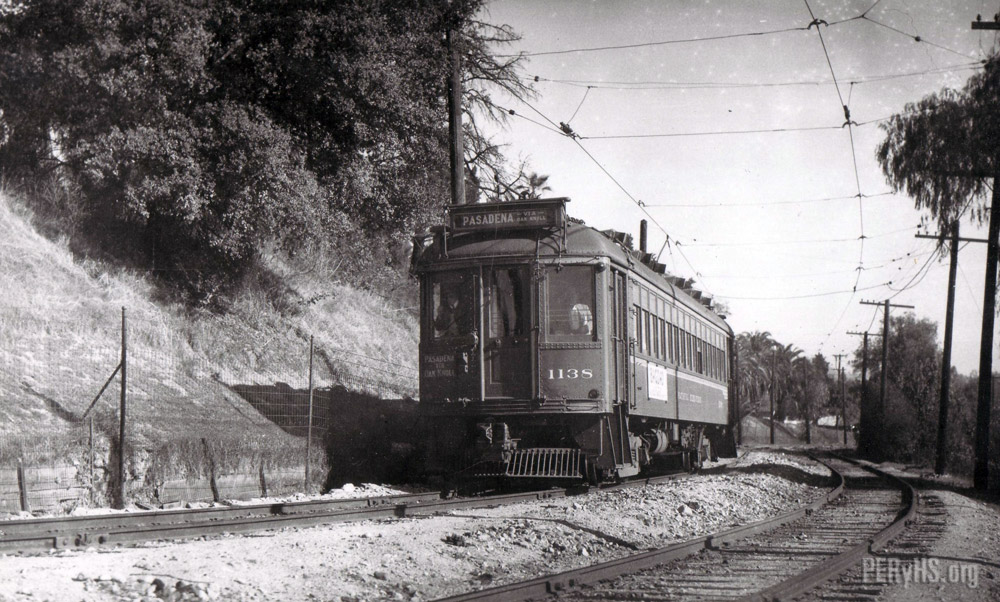
And what of 1450 Hillcrest? In 1920 no one is found to be living in the house. Howard & Leslie Huntington are still living in their home down the hill at 1079 Old Mill Road. But as noted above, Howard died in 1922, leaving widow Leslie with their four children. By 1924 she becomes engaged to James Brehm, a wealthy real estate investor, and a widower with children. And their new house for the combined families? Yes--1450 Hillcrest, where Leslie and James remain until their passings, two months apart, in 1962. After their deaths, the house was demolished, the property subdivided, and today there are three houses on the site, one of the addresses is today's 1446 Hillcrest Ave. Coincidentally, one of Henry Huntington's most profitable lines on the Pacific Electric Railway (called the Oak Knoll line) ran just south of the Hillcrest Ave. property (more detail in map below).

P.E. Railway on the private right-of-way below the Hillcrest House
(date unknown) (courtesy of peryhs.org)


And lastly--Eugene and Ione had no known children, but Eugene's brother A. Walter did.  While Walter was in Ann Arbor, Michigan, he and Louise became parents to William Redington Hewlett (1913-2001), Redington being a family name on his mother's side. And what became of William (Bill) Hewlett?  With father Walter's death early on in 1925, son Bill committed he would attend Stanford and while there in the 1930's, he hit it off with another student whose name you already know, David Packard. They went on to found their scientific instrument company, Hewlett-Packard.

Uncle Eugene and Aunt Ione--who knew?


Additional Information:
1930 Sanborn Map of the area
An interesting aerial of the Baroness Zimmerman house next door
El Paso article on Hewlett Case 1914

(Author's note: this is my favorite post in the blog)


Wednesday, July 20, 2011

Henry Newby -- Ford Place, Pasadena

Ford Place Ad 1903

It was 1905 and sales at the exclusive subdivision Ford Place (with entry posts and chains to denote the private street within) were heating up.  An ad from 1903's Pasadena Star noted:


"Destined to be the most desirable and exclusive residence portion of Pasadena. A perfect park in itself. From nowhere within our city limits can such a view of the glorious mountains be obtained. There is a building restriction on each lot, which is a guarantee of elegant surroundings. But five minutes walk from the business center, and within 400 feet of the car line. Ford Place is connected with water, gas, electric lights and every other convenience. Prices no higher than surrounding property."

Ford Place--Herkimer (Union) St. Entrance ca. 1908
B.O. Kendall was well known for his realty services in Pasadena, and Henry H. Newby (1868-1928?) was ready to make a move to something grand, now that he was President of the Pasadena National Bank. Life was good.  He'd come to Pasadena in 1887, and went to work at the First National Bank of Pasadena, staying there until 1900, working his way up to Cashier for the bank.  Brother Luther and sister Alberta came out from Indiana too, and all resided in Pasadena. Living in Ford Place with his wife Pearl (1868- ) and daughter Marjorie (1897- ), the new house turned out to be a brief stopping point in a multitude of Pasadena addresses over the next 25 years.

The  Newbys moved in to their beautiful new house at 95 Ford Place, from only a few blocks away at 397 N. Marengo. Note the entry pillars in the new house photo below as their lot bordered the north edge of the private subdivision.
95 Ford Place in 1906
At the right rear of the photo a large building appears--it was labeled as Pasadena High School in the 1905 Sanford maps--LAPL has a photo but calls it John Muir High. It was located on Walnut between Los Robles and Euclid and was demolished by 1951.
They didn't stay long. In 1913 the Newbys moved to 946 S. Madison. They were probably renting as they awaited the completion of the new, very grand home being built at 1015 Prospect in the new west side addition overlooking the arroyo. This Prospect addressed home still exists, and is a registered Pasadena Landmark.  Here's a quick peek at that house ca. 1915.

Newby Residence in Prospect Park
The 6,000+ sq. ft. house was even part of the Pasadena Craftsman Weekend in 2010. Life was still good in 1915, it appeared. Newby even joined the board of directors for the Tournament of Roses with our old friend B.O. Kendall.

In 1914 J.B. Coulston, owner of two other Pasadena banks, leads a takeover of Pasadena National, resulting in a merger creating one bank named National Bank of Pasadena. Coulston is named president of the bank. E.J. Pyle, who has followed Newby in his career, is named Vice President, and Herbert Holt (Newby's brother-in-law) is named Assistant Cashier. Newby seemed to have no active, day-to-day role in the bank, being named president of the board of trustees.  The article noted that "Newby eventually sold his interests to Coulston and retired from the banking business—with a host of well wishers and a rare personal popularity behind him."

Newby in the hotel business

But even if Newby was well-liked, his personal life took a significant turn. In February, 1919, the announcement at right showed up in the New York based Financier publication. It seems a rare change of career to move from bank president to hotel assistant manager, but that is what the article quoted.

By 1920 Newby, Pearl, and Marjorie are all living with sister Alberta and brother-in-law Herbert.  Henry's occupation in the census is listed as "Mgr. Hotel".

In 1922, Pearl and Marjorie have moved to 491 Center St. without Henry. Later in 1924 the family all show up at 2930 N. Holliston in Altadena. The next year a financial advertisement proclaims Henry as director of the Pasadena Building and Loan Association. Next year Henry is shown on the Annandale Golf Club course with the president of the Pasadena Golf Club. (J.B. Coulston was a member at Pasadena--I'm betting Henry belonged to Annandale).

By 1926 Henry is now living at the Huntington Hotel, working there as assistant manager for his former business associate J. B. Coulston, while Pearl and Marjorie reside at 20 Ford Place. Henry's last reference is at the Huntington Hotel in 1928, while Pearl and Marjorie are at 619 S. Los Robles (which was on the same block with Alberta and Herbert).

The 1930 census shows Pearl and Marjorie (now age 34) renting at 619 S. Los Robles for $60/month. They did have a housekeeper in the house with them.

And what happened to 95 Ford Place? Well in the late '20s it changed addresses to 175 Oakland, and has ended up as part of the Fuller Theological Seminary campus. The building on the lot appears to be a commercial building used for rental businesses--it has a new address--490 East Walnut. Today (thanks to Google):
Today's 95 Ford Place

Link to Google

Tuesday, July 12, 2011

B.O. Kendall -- 210 S. Los Robles, Pasadena

Arriving in Pasadena in 1886 with his wife Jennie (1859-1888), Bela Otis Kendall (1862-1942) was just in time for the great real estate boom in Los Angeles.  He jumped in beginning in August of that year and never looked back. Next year was the bust, but B.O. evidently did O.K. as by 1896 he had commissioned a new building at 61-69 N. Raymond to house his business (and others.)  This was one of the very few Greene & Greene commercial commissions done, before the Greene brothers rose to fame in the world of Arts & Crafts residences (can you say Gamble House?). Today it still stands on the northwest corner of Colorado Blvd. and N. Raymond Street (although the building was altered significantly in 1929). B.O. was to keep his real estate office at this address for his entire career--which ended around 1936.

65 N. Raymond, courtesy of bing.com/maps
Link to Larger Image

Wife Jennie W. passed away in 1888 shortly after a daughter Jennie was born in 1887, and by 1891 B.O. had married Belle Rigg, daughter of Dr. Thomas and Elizabeth Rigg, a well-known family in Pasadena. They had two children, Jackson (b. 1896) and B.O. Jr. (b. 1909) and in 1900 the family was living across the street (213 S. Los Robles) from their soon-to-be long-time house, probably awaiting the new house to be finished. They moved in shortly thereafter to 210 S. Los Robles and were to stay there for 25 years. The house as it looked in 1906 awaiting the arrival of B.O. Junior:
The B.O. Kendall Residence at 210 S. Los Robles
With the arrival of B.O. Jr. a new wing was added--the gable on the right above was extended another 15-20 feet, providing more space for a growing family.

The Electric entry of 1911
Double Delight Rose
B.O. stepped up to Pasadena community service too, serving first on the board in 1915, then in 1917-1919 as President of the Tournament of Roses Association. Son Jackson got in on the parade action one year with his electric car "float" in the 1911 parade, earning a Third Place in Class W - Electric Autos!


Next door to the south of the Los Robles home stood the Shakespeare Club, one of the oldest women's clubs in Southern California, and of course Belle was a member when in 1924 the club added a new auditorium by buying the next lot to the south of them. The club finally moved to new digs in the 1970's but still exists today with a building on Grand Ave. in Pasadena.

The Kendalls in 1923
In 1922-23 B.O. developed one of his best known neighborhoods, Oak Knoll Gardens, a development of 23 upper-middle class cottage style homes at El Molino near California.  No doubt he used some of those profits to create a new personal residence, for in 1926 B.O. and Belle decided to move to a more upscale area of Pasadena, creating a 6,000 sq. ft. house at 500 Linda Vista Drive near the Rose Bowl. Built on a 47,000 sq. ft. lot, the house contained seven bedrooms and six baths.  Their daughter and son-in-law moved into the old house on Los Robles, and B.O. Jr. moved to the new house.

Around 1936 B.O. (who was now 70+) decided to retire.  He and Belle bought a home in Avalon, Catalina Island (but maintained their voting residence at the old Los Robles house), where B.O. subsequently passed away in 1942. He was interred alongside his first wife Jennie in Mountain View Cemetery in Altadena. The Los Robles house was noted as apartments in 1951 on the applicable Sanborn map.

So where is the Los Robles house today? Well, if you stand in the middle of the street facing east at the intersection of Cordova and Los Robles, you'd have about the same view as the original photo of the house above. Sometime after the sale of the Shakespeare Club, the city came through creating a new east-west corridor (Cordova). So all traces of the old house are gone.

Monday, March 28, 2011

Busch's Gardens--Orange Grove Blvd., Pasadena

Busch Gardens, Van Nuys in 1968--plant is the building at back right
I can remember in 1968 going to the Busch beer factory and gardens in Van Nuys. After a monorail tour of the factory, you were dropped off at the back in a huge garden set up. With beautiful greenery everywhere, it was inviting to taste the various Busch products at no charge (at the time Michelob, Budweiser, and Busch Bavarian) while one strolled the gardens. Like many others, I had no idea of the history...it all started in Pasadena.

Adolphus Busch (1839-1913) was a successful brewer, emigrating from Germany, then partnering with his wife's father in St. Louis. His idea of using pasteurization and of creating a light lager that was acceptable to a broad section of the population (it's called Budweiser) made him a very wealthy man.

Cravens Residence, ca. 1903
Wanting to spend winters in a warmer clime, he purchased "Ivy Wall" in Pasadena from the John S. Cravens family around 1905. Located at 1021 South Orange Grove Ave., the large house was a Frederick Roehrig designed Tudor mix built in 1898. With a 150 ft. frontage, the lot extended deeply along Arlington Ave. to the south. The Cravens moved only a block south to the rest of their property where they built a large mansion at Madeline Dr. That house is now owned by the American Red Cross, San Gabriel Pomona Valley Chapter.


Evidently it had been in the plan to develop the arroyo behind the house into lush walking gardens from the beginning, and by 1909 it was one of the most popular tourist attractions in Southern California, with trolley car lines announcing special "Triangle Trolley Trips" that included the Gardens, Santa Monica, and L.A. oil fields! Adolphus continued to purchase land behind the house (as well as to the north) such that he ended up with over 30 acres in gardens, with major divisions of an upper arroyo and lower arroyo. A significant addition was the purchase of the former Thaddeus Lowe house (he of the famous Mt. Lowe Railway) and gardens in 1910.

Upper Arroyo Gardens ca. 1915 (Ivy Wall at upper rt. behind trees)
Thaddeus Lowe House (with flag) at upper left

The house and property were in wife Lilly's name, so the gardens continued when Adolphus passed away in 1913.  Upon Lilly's death in 1928, no future plan for the gardens had been made, and so they were closed to the public. In 1937 parts of the upper garden were sold and subdivided, and in 1943 the house was sold by the Busch estate, and the house was then razed in 1952.

The lower gardens were offered twice to the City of Pasadena, but refused because of perceived high maintenance costs. In 1949 the lower gardens were sold and the property developed into residential lots and houses.

Today remnants of the original gardens rest along each homeowner's property in the arroyo, including the Old Mill, and one of the concrete water fountains, along with some of the original wire fencing. A recent tour in 2010 by Pasadena Heritage allowed tourists to once again see "Busch's Gardens".

Ivy Wall ca. 1910 with Arlington Drive in front

And once again in 2014 another Pasadena Heritage tour was organized.

Sources:

1. Sam Watters; Houses of Los Angeles 1885-1919

2. PasadenaGardens.com
3. Postcards of the Gardens


Wednesday, February 23, 2011

William H. Vedder -- 400 N. Madison Ave., Pasadena

Today's beauty was the pride of former mayor and successful Pasadena banker William H. Vedder. 

Married to Hattie Furbeck, both were from New York and came to Pasadena in 1889, after a successful run in the lumber business in Schenectady. Living with daughter Grace and a servant, here's their home as it looked in 1906:

400 North Madison in 1906
After serving as mayor in 1903-1904, William continued in business as Director, First National Bank, President of Pasadena Savings and Trust Co. and Director of the Pasadena Masonic Temple Assn. In most of the 1910's he was on the board of the Throop Polytechnic Institute, known today as Cal Tech. 

In 1903 a book on Pasadena Residences was published; the Vedders lived at the same location but check out the house photo shown below:

(courtesy of Archive.org)

It appears the house was greatly remodeled in the short time they lived there. The Sanborn map of the area for 1903 shows an empty lot. The 1910 version shows the large bay window, which is not there in 1903. But even with the major remodeling they were soon to move. They located at 424 Arroyo Terrace in 1907, probably awaiting the completion of their new house a few blocks away at 500 Prospect Square (now Prospect Blvd.) A contemporary image of the Prospect Blvd. house is below.


500 Prospect Boulevard Today
But by 1920 the Vedders had moved again and were living next door to daughter Marguerite and her husband Stanford Dalrymple, along with their children. In November, 1923 William passed away after taking care of Hattie for over a year as her health deteriorated. Hattie died two months later. They were both age 61.

The Madison house was demolished for twin apartment houses on the double lot.

Old Homes of Los Angeles W. H. Vedder

Thursday, December 23, 2010

Rt. Rev. Joseph H. Johnson
415 S. Grand Avenue, Pasadena

(updated October, 2017)

Next up was a grand house on Grand Ave.  The Right Reverend Joseph Horsfall Johnson(1847-1928), along his wife Isabel (1851-1940) and only son Reginald (1888-1952), had moved in sometime prior to 1900.  In 1903 the City of Pasadena published a book extolling the virtues of the city--the Johnson's house was included.

The Johnson Residence at 415 Grand Avenue, 1903
Rt. Reverend Johnson commuted each day to his office in downtown Los Angeles near St. Paul's Cathedral--after all he was the Episcopal Bishop for Southern California, a job he took in 1896. No doubt he approved of the Pasadena Short Line, opened in 1902, which shortened his commute significantly.

In 1909 he founded Bishop's School in San Diego with the financial help of the Scripps sisters. By 1912 he was heavily involved with Pomona College, serving on their Board of Trustees. It was probably good odds that Rev. Johnson was a key link that allowed for the creation of Scripps College (also part of the Claremont Colleges).  

Around 1910 son Reginald, still living at home, began his architect career, and would go on to become well known for his designs of churches (including St. Paul's Episcopal Cathedral, which his father consecrated) and single-family residences.

Below is the photo that appeared in our book. The image had not changed from an earlier 1906 edition.


415 South Grand Avenue circa 1906


Rt. Rev. Johnson ca. 1910

The Johnsons in 1921
 In 1921 the Johnsons decided to take some time off.  Applying for passports to go to Europe, Rev. Johnson cited "health" as the object of his visit. At the time he was 74, and Isabella 71.

In 1923 Rev. Johnson presided at the funeral of Arthur Letts, Broadway Department Store founder. As thanks, the Letts' children donated funds to provide a new pulpit for St. Paul's Cathedral.
 

It appears that son Reginald designed a house in the Huntington Library area intended for his mother and father in 1927. Sadly, Rev. Johnson died in 1928 and is buried at San Gabriel Cemetery. After his death, Isabel moved out of the house to a new one designed by son Reginald, located at 1590 Lombardy Road. With her son's house at the other end of the block (1380 Lombardy), she remained at this address until her death in 1940, and was buried in the same plot with Joseph. Reginald and his wife Kathleen are buried there too.


Today's house was built in 1929 in the Georgian style, by son Reginald, and became known as the Francis House. From aerial photos the lot appears to be about the same size, with the Arroyo Seco starting behind the house, providing great views across the canyon. 

A 2010 aerial image of the property


Old Homes of Los Angeles