Showing posts with label West Adams. Show all posts

Sunday, December 9, 2012

William S. Bartlett -- 2400 West Adams Street

Golden Spike, gift of David Hewes
to Stanford Univ.
When William (1844-1915) and Franklina Gray Bartlett (1855-1934) moved to Southern California in 1881, it was for a common reason--warmer climate to improve health. But it wasn't for them.  Franklina's mother Matilda Gray Hewes, suffered from bronchitis. She arrived first with husband David (Franklina's stepfather)  and settled in Tustin.

David Hewes was a successful capitalist, well known in San Francisco.  Good friends with the Big Four of California railroad fame, he was originally offered a chance to participate in the transcontinental railroad, but he dismissed it as "too risky". He did however, celebrate the railroad's success, providing the golden spike for the railroad meeting ceremony in 1869 in Utah. When the spike was cast, the "sprues" (leftover metal edges) were used to create souvenir gold rings, one of which passed down to Franklina after Matilda's death in 1887.

Franklina Gray Bartlett, 1876 William Bartlett, ca. 1881
Upon Matilda's death David returned to San Francisco, and subsequently married again to Anna Lathrop, sister-in-law to Leland Stanford. Tragically, she passed away in the mid 1890's, after which David returned to Orange County and created a large citrus ranch, which he ran until his death in 1915 at 93 years of age.

While in Tustin, Franklina started the Ebell Society of Santa Ana Valley, modeling it on the Oakland society, where she was its first president. William continued with his banking career, starting multiple banks in Orange County, including the Bank of Tustin. Both were involved in the local Presbyterian church, where father-in-law David had donated monies for a new building. The Bartletts knew the pastor James French well, as he was related to Franklina. By 1898 the Bartletts moved to Los Angeles, first settling at 322 W. 27th Street with their three children Lanier (1879-1961), Matilda Franklina "Lina" (b.1886), and Gordon (b.1894). William worked downtown as president of the Union Bank of Savings, which was easy to reach on the West Adams St. Line to downtown ending next door at Arlington and West Adams.

In 1904 the Bartletts moved west to the city limits, out on fashionable West Adams.  Across the street in the brand new neighborhood were the Fitzgeralds, while directly east was the Childs family, and Dr. E.A. Bryant, chief of L.A. County Hospital surgery, to the west. Their property on the south side of West Adams sat on a ridge with an excellent view south to the bay.

West Entry Drive to
2400 West Adams (later 3200) ca. 1910

German-American Bank
W.S. in 1903
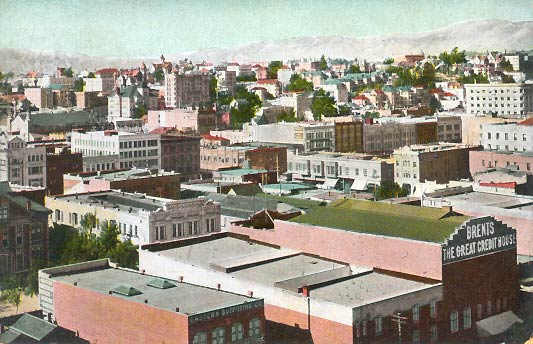
Soon after moving into Fenton Knoll (as it was named), William's bank, the Union Bank of Savings, was merged into the German-American Savings Bank. William continued as president of the  combined institution. The bank closed the old German-American location, and continued to do business at the Union Bank location at 4th and Spring Sts., albeit with a new, large sign (see postcard image).  The bank continued to grow, and by 1912 they had leased space in the new A. G. Bartlett building at 7th and Spring Street. A.G., not apparently related to William, made a lot of his money in the music business, which is chronicled in an article about his successor, John Fremont Salyer.

By 1910 son Lanier had struck out on his own, moving to the Hollywood area where he became a successful writer. His best known work, Adios, authored with his second wife Virginia Stivers, was made into a successful movie in 1930, entitled The Lash, starring Richard Barthelmess and Mary Astor.  The rest of the Bartlett family (W.S., Franklina, Lina, and Gordon) celebrated with a round-the-world cruise, which began in February in San Francisco on the S.S. Cleveland.

East Entry Drive ca. 1912
(courtesy USC Digital Archive)

Lina in 1908
Sadly, in October, 1914 the Los Angeles Times reported William's "sudden death" on Saturday the 10th. A funeral was held on the 12th at the West Adams Presbyterian attended by "many neighbors and friends". It was reported that William left most of the estate to Franklina.

One of the "friends" attending may have been James H. (Jim) French, son of Reverend Junius French from the early days in Tustin, who was in fact a second cousin of Lina.  Jim was listed as a teller at the German-American Bank in 1915, and the directory showed his residence as one and the same as Franklina and daughter Lina.

Jim went on to marry Lina later that year, with the wedding and reception taking place in the rear garden at Fenton Knoll. With Jim's father Junius officiating, the family captured the moment on film and we are fortunate to present a brief video of the event below.


In the late 1910's son Gordon perished in a drowning mishap. Son-in-law Jim became an auto dealer.  He and Lina are still in the house with Franklina and house maid Anna Zackrisson (who was listed also in the 1910 census). In 1929 James is listed as an insurance agent. Their children Franklina (b.1921) and James H. Jr.(1924-1944) have now joined the family--and of course Anna is still there.

On Christmas Eve, 1934, Franklina died. The house ended up with Lina and Jim, who continued to live there with their children and Anna. The 1940 census now showed Jim's occupation as a real estate broker. That may have been because in 1941, the house was sold, and the Frenches moved to Santa Monica.  The buyer was the Armenian Apostolic Church, which named their new church St. James.

The parish dedicated a new sanctuary building in December 1957, which could be used as an unofficial end date for Fenton Knoll.
The new sanctuary ca. 1958 for St. James

In 1963 the church sold and moved to new quarters on Slauson Ave.  The buyers were the Apostolic Faith Home Assembly Church. 

A not-too-far-in-the-past shot of the property at 3200 West Adams
A large addition in the back lot stretched the church financially, resulting in the eventual purchase for its current use, Frederick Douglass Academy High School, as an effort by the Los Angeles Unified School District (LAUSD) to improve education results through the use of charter schools.
The Frederick Douglass school closed in June, 2015. It became a LAUSD charter school focused on math and science preparation.

A 2018 photo of the school (courtesy of Google Maps)

More info:

1903 biography on Mr. Bartlett

Link checked 8/29/18

Wednesday, August 29, 2012

Joseph D. Radford -- 1124 West Adams Street

Born in Fond Du Lac, Wisconsin, Joseph (1857-1918) married childhood sweetheart Mary Pinney (1857-1901) in 1881. Soon after they moved to Bozeman, Montana as Joseph continued his career in banking. In 1887 his only child Ruth was born there. Mary's health was not holding well, so in 1896 the family moved to California in search of better climes.

San Jose News, Nov. 1901
Joseph continued in the banking business in California, finding a position as assistant cashier at the National Bank of California in Los Angeles. He also became a director of the bank, along with another gentleman of mention, Nathan W. Stowell, a local iron pipe manufacturer, whose wife Florence (known as Flora) was active in Los Angeles society.

In 1898 the family moved to San Jose, where Joseph had been promoted to cashier at a bank there. Sadly, in 1901 Mary passed away due to her poor health. The Radfords were so well-known in San Jose that her death made the local paper.

Participating in statewide banking conventions, Joseph became well-known throughout California in the banking community, so it was no surprise when in 1907 he was named as Vice-President of the German-American Bank in Los Angeles. Ruth and Joseph moved back to Los Angeles, where they took up residence on West Adams.

Their new, eleven-room home on West Adams had been purchased in 1906 by investor Charles Pregge, who had paid $16,500, buying it from the estate of Charles & Melissa Clarke, he a retired distiller from back east in "cold" country.

1124 W. Adams in 1909

Joseph engaged himself in many charitable organizations around town, including the YMCA/YWCA, where he may have crossed paths again with Flora Stowell, who was also active with the YWCA. Flora was now divorced, coming off an ugly parting from her  husband. It appears that in 1905, Professor William and Mrs. Wilkinson of Chicago were visiting Los Angeles, where their daughter Evelyn became ill from smallpox. Flora, who was immune, volunteered to care for Evelyn, age 20, as her parents needed to return to Chicago. Staying in the Stowell home, she and 58-year-old Nathan fell in love. Nathan divorced Flora while in El Paso, providing a settlement of $150,000 and a house to Flora as he went to Chicago and married Evelyn despite her parents' disapproval. The disapproval became public with a news article in June, 1905 published in the New York Times, as well as the local L.A. Herald, in which the Wilkinsons disowned their daughter.

In October, 1908 widower Joseph married Flora at the home of Flora's mother, surrounded by a small group of relatives and friends, according to the article. The wedding was officiated by the Reverend Robert J. Burdette, who edited the book from which these blog house photos were taken.

The Banks of Los Angeles in
the Celebration Booklet
By 1910 daughter Ruth had married and moved to the Imperial valley. Joseph continued with banking, leaving the German-American Bank for a position as vice-president at Hibernia Savings Bank.

Joseph in 1913 in
the Celebration Booklet

 In 1913 Joseph led the commission charged with celebrating the new Owens Valley Aqueduct. Along with the celebration ceremony itself, a 50-page booklet was produced by the Commission, which was provided to invitees of the formal celebration. Besides photos of the aqueduct, the booklet extolled the virtues of the chief engineer, William Mulholland, as well as providing self-adulation of population growth, the post office, Exposition Park buildings, and growth of overall business in the area. Interestingly, one of the pages featured banking, and of the five images shown, two were banks that Joseph worked in.

In 1914, doctors advised Joseph to step down from his banking positions, so he retired, but continued in public service as President of the Los Angeles City Board of Playground Commissioners, which he joined in July, 1913. He served as its President for three years, followed by additional service until December, 1917 when he resigned, probably for health reasons. He passed away the next year, and is buried at Forest Lawn, Glendale. In 1919, the Commissioners added a new city-owned camp in the Big Bear Lake area to its holdings, naming it Camp Radford in honor of Joseph.

Flora remained at the house at 1124 West Adams, joined by her niece Ethel Rivers Hopkins in 1920, along with Ethel's son Vance. Flora passed away in 1943 at age 82, and is buried alongside Joseph. Ethel remained in the house, with Vance coming and going. Their last recorded mention of being in the house was in 1954. By 1956 there is no listing for the house, which was purchased by the Sisters of the Company of Mary, who own the house and lot next door at 1100 West Adams.

From aerial photographs, it is apparent that today's apartment building was erected prior to 1972. It is known today as the St. Joseph Residence.  Ethel passed away in San Bernardino in 1960, while Vance died in San Diego in 1968.

Today's 1124 W. Adams

The orientation of the front apartment building aligns with the former house located on the lot.

Additional info:

Joseph Radford photo/bio in 1910

Link Checked 2/2/20

Thursday, July 12, 2012

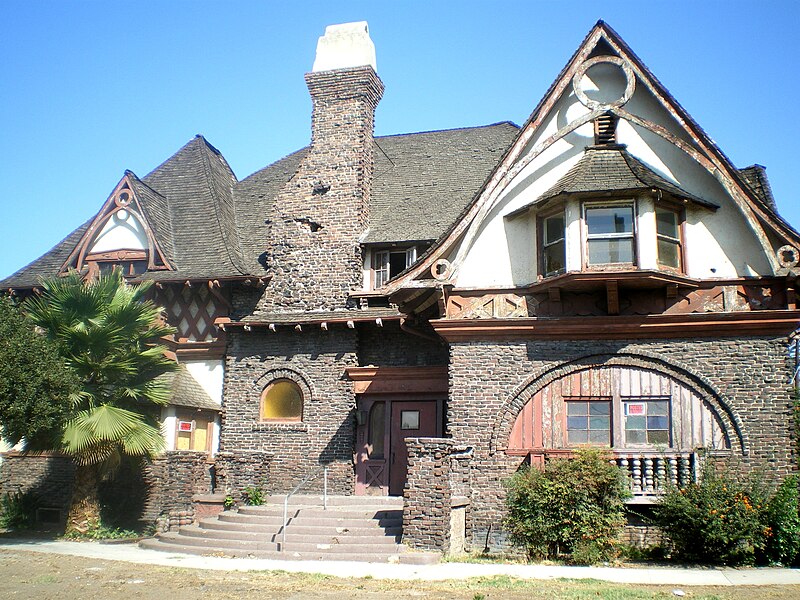
James T. Fitzgerald -- 2315 West Adams Street


Coming to L.A. in 1891, James Taber Fitzgerald (b.1864) first joined in the music business with Frederick Blanchard, selling pianos and organs downtown at 113 S. Spring Street. By early 1898 they had dissolved their partnership (albeit a little roughly--as J.T. pleaded guilty to battery against Fred in August of that year), and J.T. took over the store. Fred formed his own piano store and music hall, renting an entire building built for him by Harris Newmark in the 200 South block of Broadway.

Anne Fitzgerald in 1905 ready for the
annual Ebell Club Luncheon
J.T. ran a very successful business. Perhaps even piano teacher Miss Emma Summers, who lived less than a mile away from the Spring Street store, may have visited his store to purchase a piano, after one of her successful oil strikes.

So profitable was the business that in 1903 J.T. and wife Anne (1867-1955)commissioned a design for a new house at 2315 West Adams, selecting well-known Joseph Cather Newsom as architect. The Los Angeles Times was effusive in its praise in a 1904 house article written just prior to its being finished.
 "It will be a twelve-room two-story brick and stone structure with shingle roof and frame gables. The latter terminate in acute angles, and with the ornamented work employed are themselves calculated to produce a very pleasing effect. The clinker-brick chimneys, and the curved-recessed nook, in the southeast corner of the house blend harmoniously with the other exterior features, and help to make this one of the most attractive residences now in course of construction in this portion of the city. The interior finish will be in selected California redwood, with a dull gloss employed to bring out the fine effects of the natural grain. Five handsome mantels covering five open grates will contribute to the completeness of the interior decorations, as well as to the comfort of the occupants of this home. The house will be heated from a furnace in the basement, and provided with modern conveniences generally. It will cost between $12,000 and $15,000 and will probably be ready for occupancy in about six weeks."
Our Photo of 2315 West Adams in 1909

By 1905 J.T. and Anne had moved in to the fashionable 6,600+ square foot, six bedroom Italian Gothic mansion located on three street lots. Although there were no children, Anne and J.T. certainly had maids and other staff to allow for "breathing room" in the new expanse. Unfortunately the happiness was soon to fade.


On November 18, 1907 around 9:30 a.m. in the morning, Mrs. Fitzgerald had just left her home for a drive, the horses being driven by Joseph Wiebel, husband of the maid who was left to care for the house. She had barely turned the corner out of sight when two men entered the house through the front door. While one man kept the maid Mrs. Wiebel, covered with a revolver, the companion made his way upstairs searching for money and valuables. They were no doubt disappointed to learn in the next day's newspaper that they had "overlooked a number of pieces of valuable jewelry, valued at $3,000, which had been hidden by Mrs. Fitzgerald in a slipper, which she had stored in the drawer of a bureau in her bedroom." The article in the L.A. Herald termed it "the boldest daylight robbery in the history of Los Angeles".

Whether or not they were bothered by the robbery is unknown. But by the 1910 census the Fitzgeralds had moved to South Pasadena with their adopted daughter Louise (b. 1907), with a boarder and two new servants also there. But South Pasadena must have been too quiet, as by 1915 they'd moved back to West Adams less than a mile away to 2445 S. Western (which was the northwest corner lot at West Adams Street.) Perhaps they spent more time at the country "ranch" they picked up in 1909, Seven Hills in Tujunga. Today that ranch is a subdivision, but a painting of the house still exists. (So are there seven hills in this painting?)
Seven Hills Ranch (courtesy of CSU Northridge)

So who came in next to own 2315 West Adams? No one, per se, as in 1912 the city came through and renumbered West Adams, removing eight blocks forever from Los Angeles.

The next recorded owner to move into the house (now located at 3115 West Adams Street) was James C. Haggarty, son of J.J. Haggarty, well-known downtown merchant. James was employed as Secretary-Treasurer of the New York Cloak and Suit House, as his father's establishment was known. By 1929 street directories listed employees as working at "J.J. Haggarty", but there is no J.J. Haggarty Store listed, only the New York Cloak & Suit House.

James and Stella pose for
passports, 1923

In 1915 James rented the house, but had purchased it outright by 1920.  Born in 1890, he lived there with wife Stella, children Jack (1915-1949) and Elizabeth (b.1918), Stella's mother Clara Hayden, and one female "servant", probably a maid. Interestingly James was born in Montana, but his father's biographies do not list James nor any travels to Montana, they only mention J.J.'s marriage to Bertha in 1901. Turns out James was J.J.'s only son, and James must have connected with J.J. sometime after 1900 when James and his mother had moved to Indianapolis. It is pleasing to know that James did visit his mother. It was noted in an Indianapolis paper in May, 1922 that "Mrs Emma C Haggarty, 1712 N. Penn. St. accompanied by her son James C Haggarty of Los Angeles, CA, left yesterday for Louisville, Ky, where they will attend the races." Perhaps they were able to watch Morvich win the Kentucky Derby that year.

In 1934 the Haggartys abruptly left--holding a lawn sale of their furnishings according to a Los Angeles Times article at the time.  They moved to 464 N. Orange Dr.--north of Wilshire, of course, as by this time the West Adams corridor was beginning to decline. The following year father J.J. died, and his "Castle York" was sold as a rooming house. A couple of years later it was up for resale and stood empty, which no doubt contributed to the fire there in 1938.

The House circa 1937 (from lapl.org)


When being a prima donna was a good thing
(courtesy Ancestry.com)
In 1936 Charles de Zaruba and wife Emma Loeffler arrived on the L.A. scene. With son Lionel in tow, they were transitioning careers.  Emma, as listed in a 1928 book on Women of the West, is discussed at left.

"Former prima donna with the Manhattan Opera Company of New York; Considered an authority on voice, opera, and traditions; one time head of Voice Department, New York College of Music", just some of the accolades for Mme. Zaruba.

In their 1936 listing in the Los Angeles Street Directory, they have changed careers--prohibition had just ended three years prior--they now owned the Crescent Liquor store at 142 North Main in downtown L.A. Emma ran it with son Lionel--Charles passed away at the home later that year.

What level of success they had with alcohol is not known, but it is known that in 1940 a probable caretaker was now in residence at 3115 W. Adams.  James and Acola Johnson rented the house at $20/mo., which according to the census, was quite a bit below others on the same page. The Johnsons had just moved out to L.A. from Philadelphia, and were probably in transit.

Time marched on, but the Italian Gothic still stood, avoiding the demolitions after the war that were taking place up and down the street, and in 1952 it caught the eye of a group of lady circus performers, the Regular Associated Troupers. They were looking for permanent space for their meetings and this seemed to fill the bill. Billboard Magazine of November, 1952 documented the exciting news.


 To become a member of the Regular Associated Troupers, you had to be female and have been in "outdoor show business" for at least five years and actively engaged in the business. They did have a men's auxiliary that was about equal size to the organization (about 180 men and women total). When they honored men in society, they gave them feminine names, e.g. Claudia for Claude, as they would not allow men's names to appear on their rosters. (They however did not seem to get it right for the Billboard article...)

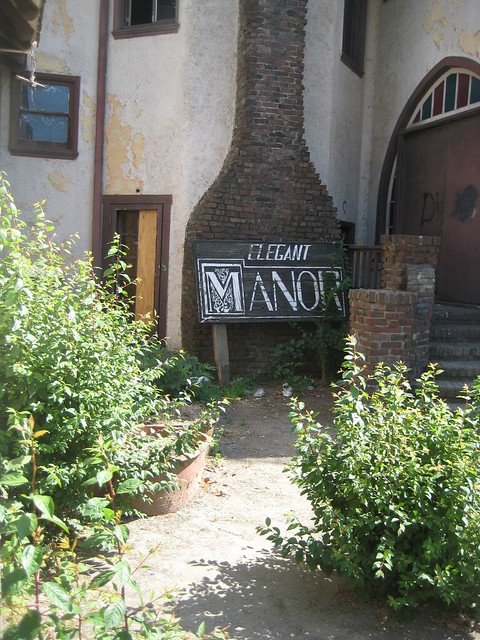
By all accounts it was a good fit, but by the mid-'70s the Troupers had faded, and had put the house up for sale. This time it was to be occupied by seamstress Arlillian Moody who had always wanted to live in an "Elegant Manor".

The L.A. Times recounts in 2004:
Ms. Moody, as everyone called her, was an excellent seamstress. She moved her operation to a house off Crenshaw Boulevard and raised three children, mostly on her own. She sent her youngest child, Lauretta Carroll, off to Caltech to study engineering. Her oldest son, Robert Carroll, spent time in San Quentin on assault charges. Later, he became a bus driver. Her middle child, Ronald Carroll, was working at Long Beach Naval Shipyard when he discovered the Fitzgerald place in 1977. The house was empty and ragged.  Most of the windows had no panes, and the steep gables lent it the air of a haunted house. Yet Ronald likened it to a big, admirable boat that would not sink.
Ronald bought the home for $49,000 that year from the Troupers organization.  The Times article continued:
Ms. Moody moved into a downstairs room, set up her sewing equipment and got to work. She enlisted family members, friends and people off the street to help with the restoration. They painted inside and out, cleared the weeds, laid sod, and planted a garden with strawberries and tomatoes.

From the ruins of the Fitzgerald home rose Elegant Manor, a curious mix of community center, dress shop, catering operation and halfway house. Ms. Moody hosted fancy weddings and quinceaneras and Mother's Day celebrations. She rented it out for TV and movie shoots. It served as a polling place and a classroom, and the occasional home to political groups, nontraditional churches and Alcoholics Anonymous meetings.
The "Elegant Manor"
in 2008
But by the mid 1990's Ms. Moody's health began to fail, and she passed away in 2001 at age 85. Son Ronald was not the same caretaker, and he let the house run down to the point there were two murders at the house in 2004. Later that year the city had finally had enough and hauled away 33 cars piled on the lot along with tons of other refuse. Ronald followed by putting the house up for sale for $1.9 million.

It appears there was some sort of sale in 2008, jointly with the large lot on the corner, but to date no real changes have occurred to the house. It was relisted in 2011 for just under $1,000,000. It is currently not actively marketed for sale.

The house sits patiently, hoping to be restored, rejuvenated, hoping not to become like the apartments to either side. Hoping...


As of 2008
(courtesy of wikipedia.org)

The house in November, 2014
(courtesy of the author)

 It appears the L.A. Angkuk Zen Center is working on the house as of May, 2019.
The Residence in May, 2019
(courtesy of Google Street View)

Additional information on the house:
J.T. Fitzgerald in 1909 
A 1909 ad for New York Cloak & Suit
A 1915 ad for Fitzgerald Music
Big Cleanup at the Elegant Manor (2004)
A Home to Faded Dreams (2004)
"Elegant Manor" Back, Still a Fixer (2011)
Needs Renovation (2015)

link check 5/12/21


Monday, September 26, 2011

J.V. Vickers -- 624 West 28th Street

John Van Vickers (1850-1912) came to Los Angeles in 1899 after a colorful past in Tombstone, Arizona.  Seems J.V. was previously Cochise County Treasurer 1888 and 1895-1896. He was there during the Gunfight at the OK Corral, building a significant cattle business, including the Chiricahua Cattle Company, one of the largest in the West.

Originally from Pennsylvania, he moved to Illinois where he met and married Anna Childs (1855-1946), who along with their five daughters came to Los Angeles with him from Arizona. Daughters Florence (1873- ) and Dora (1876- ) attended school in Philadelphia, with Florence then attending and graduating from Bryn Mawr College.  Third daughter Lillian (1879-1901) also went to Bryn Mawr, but died from a tragic accident there in December, 1901. The accident was carried by the New York Times on their front page.
"At 8 o'clock Miss Vickers rose and retired to the bathroom, situated near her own apartment.  Half an hour later she came rusing forth enveloped in flames." She died by 1 o'clock without regaining consciousness. The Times delicately stated "...the victim had rubbed her body with alcohol, which in some way became ignited." 
The New York Evening World was less delicate in their assessment.

Evening World Article on Lillian Vickers' death


To this day "ghosts" supposedly haunt the Bryn Mawr Dormitory where the accident occurred.  Daughter #4, Anna (1882- ), did not attend Bryn Mawr, instead going to the local upstart Stanford, as did daughter #5 Clara (1886- ). They were both members of Delta Gamma sorority there.

After arriving in Los Angeles J.V. continued his cattle business, which included partnering  up with Walter Vail, who was also a major rancher in Arizona. Together they formed Vail & Vickers Company, purchasing Santa Rosa Island off the coast of Santa Barbara to raise cattle, which had previously been used for sheep ranching. The island became the last ranching enterprise on a Mexican Land Grant in California, and was run by a third-generation Vail descendant. In 1980 the island was declared part of Channel Islands National Park, and the Vail and Vickers Company knew it was inevitable they would lose the land. So in 1986 the partners sold the island to the federal government, with the caveat that the company could continue ranching for 25 years.  The federal government reneged via years of lawsuits  and forced the Vail family to stop ranching in 1998. Quoting from the linked article:

"At that point the name Santa Rosa became shorthand for government treachery within the Southern California agricultural community."

In 1904 J.V. led a syndicate which bought a large parcel of land in Orange County. Realizing they needed transportation to the area if they were to develop it, they succeeded in luring Henry Huntington to extend his extensive trolley network by providing him a significant share of the operation, and even renaming the area from Pacific Beach to Huntington Beach. Little did they know the amounts of money in the ground, which did not appear until the 1920's.

Around the same time J.V. purchased a house in fashionable West Adams from Max Meyburg, a well-known retailer and light manufacturer in town.  Max had had the house built sometime around 1898, but had decided to move a few blocks west. Our 1910 photo of the house looked like the below:

624 West 28th St. in 1910

J.V. in 1910
Now located in the new social center, two doors west were the Laughlin Jr. family, and the Vickers were just two blocks from Figueroa and West Adams. By this time (1910) Florence and Anna had married, Florence in 1905 to Franklin Allister McAllister, with two daughters, and one son. Anna about the same time married a Clarence Crawford from Oregon, whom she'd met while matriculating at Stanford. Clara still lived at home.

Then while celebrating the Christmas season at home on December 28, 1912, J.V. had a heart attack while playing dominoes with his family. Clara stayed on for awhile, marrying Roy Naftzger, a real estate broker, in 1920. Mother Anna C. continued to reside in the house until her death in 1946.

A sample bookplate
Daughters Clara and Anna founded a Memorial Book Fund at their alma mater in honor of their father.  Many of the books in the library provided by the fund carried their bookplate, indicating the donor.

The neighborhood had changed significantly since the Vickers purchase. By 1942 the house was surrounded by sororities and fraternities of USC, and after wife Anna's death, the house took its new place along Greek Row. In the 1950's AO Pi sorority was in the house.

AO Pi, Nov. 1951 in the front yard at 624 W. 28th St.


By 1962 Alpha Epsilon Phi moved into the house from their smaller location a block west, staying through the 1980's. Today the house still stands, its latest resident Beta Omega Phi, an Asian-American interest fraternity. The house's outline, while substantially altered, is easily identifiable.

Recently at 624 W. 28th St.
(courtesy of the author)

By January 2023 Beta Omega Phi had left the property.

Link checked 7/19/23

Wednesday, September 7, 2011

E. J. Brent of Berkeley Square

Born of British stock, Edwin James Brent (1856-1923) first came to America in 1870, living in Indianapolis for ten years. He returned to England, married Mary West (1865- ), and came back, this time to Los Angeles, to seek fame and fortune. In 1890 he started a second-hand furniture store on the southwest corner of West 4th & Spring Streets. Business was good--within four years he opened a second location across the street in the same block.  In 1896 he moved another block south to larger digs at 538 South Spring Street in the Chauvin Building. A new building went up next door to the north in 1898, so the business relocated again. He remained thrifty with his business still, residing upstairs with Mary at that same location.

Bit by bit the business grew, but it was definitely under the town's business radar as articles about the Brents were few and far between. The business ultimately moved to 712 S. Main in 1905, where it remained until E.J.'s death in the early 1920's. Perhaps that business move was the driving force for E.J. to seek residence quarters apart from his business location.  They had their ultimate mansion constructed in a very fashionable gated community in West Adams known as Berkeley Square.  That new house hit the newspaper real estate section, and after that it was Society pages galore for Mary.

The house appears like a Craftsman on steroids.  Sitting in the middle of the block, the design of the house created odd lines when viewed as a photograph. Here it is a year or so after building...
#20 Berkeley Square ca. 1909


E.J. in 1910


The entry hall
The house received extensive coverage in the June, 1909 issue of Western Architect, with photos showing off the entry hall, dining room and exterior of the house.

And if you thought E.J. and Mary needed the large house for their large family you'd be half right--if you call servants family. Their one child E.J. Jr. (b.1903) lived there with four in-house servants.


Life seemed good for the Brents. "Brent's Great Credit House", as the business was known in local directories, continued to prosper while the family took multiple vacations, including recorded trips to Panama in 1913, and Hawaii in 1922.  One newspaper article in 1910 mentioned they "motored down to Coronado Beach last Tuesday for a week's vacation. Mr. Brent is enjoying the many beautiful auto drives in this vicinity and into the San Diego "back country" and across the line into Old Mexico."

1909 L.A. Directory Ad (courtesy of LAPL.org)
After E.J.'s passing, Mary remained in the house with her son for a couple of years more. She moved for awhile to 501 S. Manhattan, before settling down by 1930 across the street in a new fourplex at 456 S. St. Andrews Place, on the northeast corner of St. Andrews and 5th Street. The census reported her as renting at $75/month, an odd choice for one who should be able to easily own her abode. She disappears from the record by 1944.

One doesn't know if the house had been sold or not...by 1928 Winfield Scott, a local photographer, was living there with his daughter Margaret, who was listed as "artist" in 1928, and "photographer" in 1930 records. Interestingly, Mr. Scott was renting the grand house for $75/month in 1930, the same amount Mary Brent was paying over on St. Andrews Place.

By 1932 Scott had left, and a Leonard Bowie arrived, staying through 1934--then no resident can be found until 1946, when Vida Woelz turns up, joined by her husband John in 1948.

By the early 1960's a threat to all the houses in Berkeley Square appeared.  A new freeway starting at the Santa Ana Freeway (I-5) went west all the way to Santa Monica, exiting at the Pacific Coast Highway in Santa Monica. And the eminent domainers targeted the northern half of the Berkeley Square subdivision for its trip through the West Adams area. By 1965 a new eight-lane freeway began to shoot drivers (except during rush hour) across Berkeley Square at 65+ MPH. And 20 Berkeley Square had become history.


Additional information:
More on Berkeley Square
A postcard showing Brent's Spring Street store


A New Bit of Information: 

One of the challenges of following the life of a house without photos is determining what really happened to the house.  Here's a theory for this one.

The house appeared to have stood empty through the late '30s and early '40s. And while I didn't write about in the above, others have mentioned that a #20A appears for this Berkeley Square address by the 1940's.  Take a close look at the images below.  The 1921 Sanborn map has been placed above an aerial of the neighborhood taken in 1948. Our #20 lot line has been superimposed on the aerial photo in the lower half.  #20 in the aerial photo appears to be half gone--the entire eastern portion missing, the portico removed--and a new house at the rear of the lot appears with a sidewalk coming in from the street. Perhaps that's the answer.  Even before I-10 sent this house to oblivion, perhaps someone else did, turning it into two houses.


1921 vs. 1948 Berkeley Sq. 
 Sanborn map courtesy of Proquest Sanborn Maps
 

It turns out there was an updated Sanborn map done in 1951 which confirms the above.

Two homes now on lot #20


Next Up:
The Man Who Owned Santa Rosa Island

Wednesday, July 27, 2011

Homer Laughlin - No China Here

A quick scan of the internet for Homer Laughlin(1843-1913) results in tens of thousands of hits for Homer Laughlin China Co., at one time the largest china plate maker in the world. Located at a large source of clay deposits in East Liverpool, Ohio, it was indeed named by Homer Laughlin for himself, after he bought out his brother's interest in 1877. The company established itself with world-class products, as exemplified by being the only gold medal winner for ceramics at the 1893 Columbian Exposition.

By 1896 Laughlin was ready to retire.  He made some real estate investments in Los Angeles, and after his son Homer Jr.(1876-1932) graduated from Stanford that same year, they went into real estate development together in Los Angeles, living in various hotels and temporary residences.

In 1897 they'd completed the first steel-reinforced concrete fire-proof structure in the city at 315 S. Broadway, named aptly enough the Homer Laughlin Building (father or son?).  Homer sold the business in Ohio in December, and concentrated his new efforts in L.A. real estate. In 1901 father and son moved to the St. James Park area, where Homer found a suitable house a couple of blocks east at 666 West Adams Boulevard. As a long time friend of fellow Ohioan William McKinley, Homer led the reception committee for the President's visit in the summer of 1901, one of the last before his assassination later that year in Buffalo. In 1905 a new, concrete-reinforced addition was made to the Laughlin Building, which now went completely through the block to Hill Street. To prove the building strength, a test was made of applying up to 56 tons of pressure to the building. The building addition is most noted for housing the Grand Central Market since 1917.

By 1904 everyone in the family had arrived in L.A. and they moved in to 666 W. Adams--Homer, his wife Cornelia (1846-1907), daughter Guendolen (1886-1942), and son Homer Jr. An older daughter Nanita (1883-1891) had died previously in Ohio.


 A ca. 1906 photo of the house below:

 666 West Adams Street in 1906

A sample of the Keeley Cure
(courtesy of bottlebooks.com)
The house was not new when it was bought by the Laughlins. It turns out that it was owned by Mary Keeley, young widow of Dr. Leslie Keeley, inventor and franchiser of the "Keeley Cure" for alcoholism and drug addiction. This was a winter home for the Keeleys. Interestingly the 1899 Los Angeles street directory makes no mention of his occupation, while posting in bold print a few lines above the Keeley entry, the local franchise address for his "cure". The house was new in 1898 after a severe fire had burned down the previous house.

The house was probably planned to be a temporary stop for Homer, as in 1905 he purchased property between Los Feliz and Franklin with a prominent hilltop, planning to build his retirement home in the country.  Something happened to create a change of plans and the area, known today as Laughlin Park, became an upscale, gated development that housed celebrities such as W.C. Fields, Charlie Chaplin and Cecil B. DeMille (who picked off that lot at the top of the hill).

In early January, 1913 Homer came down with appendicitis, and as a result caught pneumonia and died that month at age 69. His estate was equally split between son Homer, Jr. and Guendoline. According to the L.A. Times, they split $1.7 million before estate taxes.  Guendoline kept the house and lived there until moving to the Biltmore Hotel in the late 1920's. Homer Jr. lived a few blocks south at the same house number on 28th street with his family. He continued his real estate development career for the next 18+ years. There was a Homer Laughlin Theatre in Long Beach, completed in 1915--but as yet I've been unable to tie it to Jr.

By 1951 666 West Adams had been demolished. Today the AAA Club buildings expanding west from Figueroa have usurped the former property.

A few other photos:
ca1904  USC Collections 2516
ca1904 USC Collections 202
ca1900 USC Collections 1944
A short bio and image of Homer Laughlin (1915)

Monday, June 27, 2011

834 W. 28th St. -- John H. Norton

John H. Norton (1846-1911), left his Boston area home at an early age to seek his fortune in the west. In 1864 he worked in southern Colorado as a storekeeper and saloon owner, building capital steadily. Around 1870 he sold everything and took a stage to Tucson, where he was appointed by the U.S. government as "post trader" at Fort Grant, a new fort in southeast Arizona Territory. From there he went on to found Willcox, Arizona, where his store today is on the Register of Historic Places. Joining forces with partner Madison Stewart, they created a successful stage line among other businesses in Arizona. He married Mary Frances Van Doren (1867-  ), and in 1891, their only child Amy Marie was born in Willcox.

In 1896 they moved to Los Angeles, where Norton quickly got involved with city "movers and shakers", joining the Chamber of Commerce, and multiple Clubs, including the Jonathan and California Clubs. By 1900 the family had moved into their upper-class home in West Adams. The Los Angeles Public Library has a photo of the house when brand new.  Ours below is from circa 1906.

834 West 28th Street - home of the Nortons
While in Los Angeles he no doubt worked with his neighbors -- two doors west was John Mackay Elliott's residence, and Norton and Elliott were both directors at the Los Angeles Trust Co. (along with George Cochran). Norton also created a new company that performed railroad building work, and invested in real estate, owning the Norton block at his death in 1911.

No doubt when Mr. Norton was with friends, he became known for his stories of the "old days", as the cartoon book "As We See 'Em" by local newspaper cartoonists, showed Norton in his stagecoach still (below).

Norton on the Trail

By 1910 Amy Marie had turned nineteen, so that December her Cotillon was held at the home at 834 W. 28th, resulting in the Society section of the next day's L.A. Herald featuring a photo of Amy Marie.

Amy Marie Dec. 20, 1910

Sadly, father John passed away the next February, but Mary remained in the house well into the 1930's. After John's passing she traveled abroad with one of her servants taking multiple trips to Hawaii.

Today the house is gone (it was probably torn down after Mary's death), and the location now shows allegiance to the nearby university, as the house of Delta Delta Delta (Theta Xi chapter).

Today at the Norton Residence
(courtesy of the author)


Update: A commenter (see below) spotted that the original house is behind the current facade--below is a closeup of the top of the round tower--the decoration appears to be the original...
A closeup of the tower
(courtesy of the author)

Monday, May 2, 2011

J. Ross Clark

James Ross Clark (1850-1927) followed his older brother William A. Clark into Montana, where for 20+ years he worked in mining and banking, becoming successful in copper mines, as well as delving into railroads. In 1892 he moved the family, consisting of wife Miriam (1858-1951), daughter Ella (b.1879), and son Walter(1885-1912), to Los Angeles, where he became heavily involved in railroading and sugar beets, owning a large operation in Los Alamitos. J. Ross envisioned a railroad between Salt Lake City and Los Angeles (as did E.H. Harriman of the Union Pacific) that would allow for Montana mining materials to be more quickly shipped to Los Angeles. Brother William agreed, and along with Harriman formed the San Pedro, Los Angeles and Salt Lake Railroad in 1902. An area in southern Nevada appeared to be a good mid-point for the railroad, supplying water and crews, so in 1905 Las Vegas was born, with J. Ross auctioning off 600 plats (at the direction of Harriman).

Meanwhile the family was enjoying the new house at 710 West Adams Street, part of a growing high-end neighborhood, with families such as the Dohenys mere blocks away, Stephen Dorsey a few doors to the east, and William Kerckhoff second house to the west (you UCLA grads who think you've heard that name--yes it's THAT Kerckhoff). The house as it looked in 1906:

710 W. Adams Street
 Living in the house during the 1910 census were J. Ross and Miriam, son Walter and his wife Virginia Estelle, daughter Ella and her husband Henry Carlton Lee, along with four servants.

In early 1912 it was decided that Walter and Virginia would travel out of the country and return on the maiden voyage of the world's soon-to-be most famous ship. Walter filled out the passport paperwork in January, 1912 and all was set to travel.

J.Ross Clark witnesses son Walter's signature on his passport application Jan. 31, 1912

Ross Clark and grandparents J. Ross
and Miriam--courtesy of UNLV Collections
Virginia survived the Titanic, but Walter died in the tragedy. She returned to Los Angeles, and the house at 710 W. Adams, in grief. That fall Virginia took a "vacation" to assist in recovery, only to notify the Clarks that she had remarried to a man named Tanner. The Clarks, taking care of their grandson, immediately filed for custody of the child, which was awarded, then taken away, ending in Virginia's presence in the Clarks living room with two lawyers and two sheriffs in order to pick up the two-year old.
Interestingly, by 1920 the Clarks had the boy at their house during the census, and took little Ross with them when trips permitted.

In 1913, Homes and Gardens of the Pacific Coast Volume II Los Angeles had this to say about the Clark house on West Adams:

"The home of Mr. Clark shows many interesting English features, notably the brick and half timber construction. The training of the vines over a large portion of the exposed surface, the placing of the small trees and shrubs, and the fine old palms, give the home an air of quiet seclusion. The grounds are well laid out, and are enclosed with wrought iron fences supported by heavy cement posts, over which vines have been trained in a very pleasing manner."

Clark Mausoleum
(Note Date on steps at left)

J. Ross died in 1927, and was laid to rest in a large private vault at today's Hollywood Forever Cemetery. Miriam and James Ross II stayed in the house until after 1944, when it was demolished to make way for an expansion of the Auto Club of Southern California headquarters.


Reference: William Andrews Clark; PBS profile


710 West Adams Boulevard